
Almost every grammar lesson in school starts the same way: the teacher writes a sentence on the board and asks, “Can anyone find the noun?” Most students can point to dog or school. But when the sentence contains a word like happiness or team, the hands go down.
This guide fixes that — completely. By the end, you will know exactly what a noun is, how to find one in any sentence using three easy tests, and what nouns actually do when they show up in writing. It is written for students in Grades 1–8, and for the teachers and parents helping them.
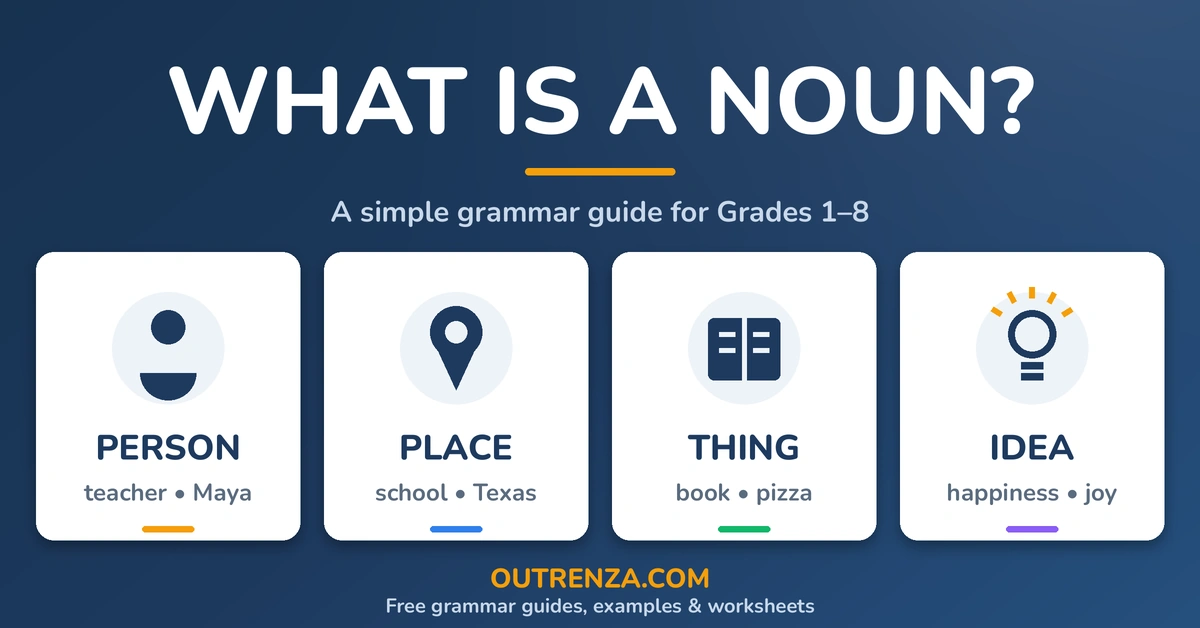
Quick answer: A noun is a word that names a person, place, thing, or idea. Teacher, Paris, bicycle, and courage are all nouns. If you can ask “who or what is this naming?” about a word, you are probably looking at a noun.
The Naming Rule
A noun is a naming word. If a word names a person, a place, a thing, or an idea, it is a noun — teacher, Paris, bicycle, courage.
1. The Simple Definition: A Noun Is a Naming Word
A noun is a word that gives a name to something. That “something” can be:
- a person — teacher, doctor, Maya, astronaut
- a place — school, park, Texas, the moon
- a thing — book, bicycle, pizza, cloud
- an idea — happiness, freedom, honesty, time
PERSON
teacher, doctor, Maya
PLACE
school, park, Texas
THING
book, bicycle, pizza
IDEA
happiness, freedom, time
The first three are easy. The fourth one — idea — is the one students forget, and it is the reason love, anger, and childhood feel confusing. They are nouns too; they just name things you cannot touch.
Teacher tip: Many textbooks still teach only “person, place, or thing.” Always add “or idea” out loud in class. It prevents the most common Grade 4–5 confusion: students rejecting abstract words as nouns. A thirty-second habit that pays off for years.
In a sentence:
- The teacher opened the book. (person + thing)
- Maya visited Texas in July. (person + place + idea of time)
- Honesty is the best policy. (idea — and it is the subject of the sentence, which nouns do all the time)
2. The Three Easy Tests: How to Find a Noun in Any Sentence
Definitions are nice, but students need a method. Teach these three tests in order — they work on real sentences, not just textbook examples.
Test 1 — The naming question. Point at the word and ask: “Is this naming a person, place, thing, or idea?” If yes, it is a noun. (The puppy barked — “puppy” names a thing. ✓)
Test 2 — The “the” test. Put the, a, or an in front of the word. If the result sounds natural, the word is probably a noun. The courage… the journey… a whisper — all nouns. (It does not work for verbs: “the run quickly” sounds wrong, because run is acting as a verb there.)
Test 3 — The capital-letter clue. If a word is capitalized in the middle of a sentence (“We met Mr. Alvarez“), it is almost certainly a proper noun — the name of a specific person, place, or thing. Capitals are nouns waving at you.
Quick test for students: Try all three tests on this sentence: “My grandmother baked cookies for the party.” Grandmother (person ✓, “the grandmother” ✓), cookies (thing ✓), party (thing/idea ✓). Three nouns, three tests, zero guessing.
Try It Now — Use the Three Tests
Find the nouns in each sentence. Use the naming question, the “the” test, and the capital-letter clue.
- The farmer fed the chickens at sunrise.
- Sara’s kindness helped the whole team.
- We heard thunder over the lake.
Check your answers
1. farmer (person), chickens (things), sunrise (a thing you can see) · 2. Sara (proper noun — the capital letter is the clue), kindness (idea), team (a group) · 3. thunder (a thing you can hear), lake (place)
3. What Nouns Do in a Sentence: Two Main Jobs
Nouns are not just labels sitting in a list — they work in sentences. At this level, students only need to know the two main jobs:
Job 1 — The subject (the doer). The noun that performs the action.
- The dog barked. (Who barked? The dog.)
- Courage helped her finish the race.
Job 2 — The object (the receiver). The noun that receives the action.
- She walked the dog. (She walked what? The dog.)
- He showed great courage.
Most sentences students meet in Grades 1–5 are built from exactly this pattern: noun (subject) + verb + noun (object). Once they can spot the two nouns, diagramming-free grammar suddenly makes sense.
Teacher tip: Ask “who or what did it?” for the subject and “who or what got it?” for the object. Students who can answer those two questions can find nouns in any paragraph — it is the single most transferable grammar skill at this level.
4. The Two Big Families: Common Nouns and Proper Nouns
Every noun belongs to one of two families, and the difference is just one capital letter.
teacher, city, dog
Ms. Johnson, Chicago, Buddy
| Common noun | Proper noun | |
|---|---|---|
| What it names | A general person, place, thing, or idea | A specific person, place, thing, or idea |
| Capitalized? | No | Always |
| Examples | girl, city, dog, holiday | Maya, Chicago, Buddy, Thanksgiving |
- A girl adopted a dog. (Which girl? Which dog? General — no capitals.)
- Maya adopted Buddy. (Specific — capitals.)
The one rule to memorize: specific name = capital letter. Monday but not day. Lincoln Elementary School but not school. This one rule fixes more student errors than any other in elementary writing.
(A full comparison with 100+ examples is coming in the dedicated Common vs. Proper Nouns guide — this page is the starting point, not the finish line.)
5. One or More Than One: The Easy Plural Rule
Nouns change form depending on number — and at the beginner level, one pattern covers most cases:
- One = singular: cat, box, baby
- More than one = plural, usually formed by adding -s: cats, dogs, books
Two common spelling twists to know early:
- Words ending in s, x, ch, sh add -es: box → boxes, wish → wishes
- Words ending in consonant + y change y → -ies: baby → babies, city → cities
Watch out: Some nouns break the pattern completely — child → children, mouse → mice, tooth → teeth. Students do not need to memorize these yet; they just need to know irregular plurals exist. (A full plural-rules table with the irregular list lives in the Types of Nouns hub.)
The uncountable exception: Some nouns have no plural at all — water, homework, furniture, advice. You cannot say “two advices.” This trips up even strong students, so flag it early.
Try It — Make Them Plural: box, baby, leaf, child, sheep
Answers: boxes, babies, leaves, children, sheep (sheep stays the same!).
6. The 10 Types of Nouns at a Glance
“What is a noun?” is the starting question — “what kinds of nouns are there?” is the next one. Here is the complete map; each type gets its own full section with 20+ examples in the hub guide:
| # | Type | One-line definition | Example |
|---|---|---|---|
| 1 | Common noun | General name | teacher, city |
| 2 | Proper noun | Specific name (capitalized) | Ms. Johnson, Texas |
| 3 | Collective noun | A group as one unit | team, flock |
| 4 | Abstract noun | An idea or feeling | happiness, freedom |
| 5 | Concrete noun | Something you can sense | rainbow, pizza |
| 6 | Countable noun | Can be counted | apple → apples |
| 7 | Uncountable noun | Cannot be counted | water, homework |
| 8 | Singular / Plural | One vs. more than one | cat → cats |
| 9 | Possessive noun | Shows ownership (‘s) | dog’s bone |
| 10 | Compound noun | Two or more words joined | toothpaste, ice cream |
📘 Read the full guide: Types of Nouns — Definition, Examples, and Worksheets — all 10 types explained with kid-friendly examples, a printable chart, and common-mistake fixes.
Teacher tip: Do not teach all 10 types in one lesson. The US curriculum introduces them gradually: common/proper in Grades 1–3, plurals in Grades 2–4, collective in Grade 4, abstract/concrete in Grade 5. This page gives students the map; the hub gives you the lessons one at a time.
7. Common Mistakes Students Make (and How to Fix Them)
- Forgetting the “idea” in the definition. ❌ “Happiness can’t be a noun — I can’t touch it.” → ✅ Ideas are nouns too: happiness, freedom, time.
- Capitalizing common nouns. ❌ “My favorite Subject is Science.” → ✅ “My favorite subject is science.” (Only specific names get capitals — “English” the language is proper; “science” the subject is common.)
- Making uncountable nouns plural. ❌ “I have two homeworks.” → ✅ “I have a lot of homework.”
- Calling every -ing word a verb. “Swimming is fun” — here swimming is a noun (the subject!). Words change jobs; use Test 1 and Test 2 instead of memorizing lists.
- Mixing up nouns and verbs that look alike. Run can be a noun (“I went for a run”) or a verb (“I run fast”). The tests in Section 2 settle it every time — “the run” ✓ noun; “the run quickly” ✗.
8. How Nouns Fit With the Other Parts of Speech
A noun rarely works alone — it teams up with the other parts of speech. Seeing the whole team in one sentence helps students stop confusing the players:
| Part of speech | Job | Example with the noun dog |
|---|---|---|
| Noun | Names it | The dog barked. |
| Pronoun | Replaces it | It barked. |
| Verb | Shows its action | The dog barked. |
| Adjective | Describes it | The loud dog barked. |
| Adverb | Describes the action | The dog barked loudly. |
Teacher tip: When a student calls loudly a noun, point at this table instead of a rulebook. Seeing all five jobs side by side in a single sentence clears the confusion faster than any definition.
(Outrenza covers each part of speech in its own cluster — this page is the noun chapter, and the starting point for all of them.)
9. Quick Test: Can You Find the Nouns?
Read each sentence and count the nouns — then check your answers.
- The cat slept on the warm rug.
- Liam and Emma visited the museum on Saturday.
- Honesty matters more than money.
- A flock of birds flew over the school.
- My mother packed lunch in a bag.
Check your answers (click to reveal)
1. 2 nouns — *cat, rug* 2. 4 nouns — *Liam, Emma, museum, Saturday* 3. 2 nouns — *honesty, money* (both ideas/things you can’t touch — still nouns!) 4. 3 nouns — *flock, birds, school* 5. 3 nouns — *mother, lunch, bag* Scored 12–14? You have got nouns down. Missed a few? Re-read Section 2 and try the three tests again.Keep Learning: Your Next Steps
You now know what a noun is, how to find one, and what the 10 types are. Here is where to go next:
- 📘 Types of Nouns: Definition, Examples, and Worksheets — the complete hub: all 10 types with examples, a free printable chart, and grade-level worksheets
- 📝 Nouns Worksheet for Grade 1 — free printable with answers
- 📝 Noun Examples (100+) — coming soon: the big example bank, organized by category
- 🎯 The Noun Quiz — coming soon: 10 quick questions to test everything on this page
Frequently Asked Questions
A noun is a naming word — it names a person (teacher), a place (school), a thing (book), or an idea (happiness). If you can ask “who or what is this naming?” about a word, it is probably a noun.
The 8 parts of speech are noun, pronoun, verb, adjective, adverb, preposition, conjunction, and interjection. The noun is traditionally taught first because every sentence needs one — it is usually the subject.
Yes. Happiness is an abstract noun — it names a feeling (an idea), not something you can touch. Abstract nouns like freedom, kindness, and courage are still nouns.
Yes. Compound nouns join two or more words to name one thing: ice cream, bus stop, mother-in-law, high school. They can be written as one word, hyphenated, or as two separate words.
A noun names something (person, place, thing, idea); a verb shows action or being (run, is, think). Some words do both jobs — “a run” (noun) vs. “to run” (verb). Use the “the” test: if the fits in front of it naturally, it is working as a noun.
English has 10 main types of nouns: common, proper, collective, abstract, concrete, countable, uncountable, singular/plural, possessive, and compound. Each type is explained with examples in our Types of Nouns guide.
Irshad Ullah Asad is a linguist (M.Phil Linguistics) and content writer who has taught postgraduate classes for 15 years. At Outrenza, he turns deep expertise into simple, practical grammar lessons for teachers, parents, and students.

Founder & Editor, Outrenza. Irshad Ullah Asad is a linguist and experienced content writer with an M.Phil in Linguistics. For the past 15 years, he has taught postgraduate classes, helping advanced students master the structure and use of the English language. At Outrenza, he turns that deep expertise into simple, practical grammar lessons — clear explanations, rich examples, and free printable worksheets — so teachers, parents, and students can learn parts of speech and core grammar with confidence. His academic background in linguistics ensures that every lesson on Outrenza is accurate, well-structured, and easy to follow.