
If you ask a child, “What is a noun?” you will probably hear, “A noun is a person, place, or thing.” That answer is correct — but it is only the beginning. The English language has 10 main types of nouns, and each type works a little differently. When students learn the types of nouns, they suddenly understand why we capitalize Monday but not day, why we say a pack of wolves instead of a group of wolves, and why we can count apples but never say informations.
This guide explains all 10 types of nouns with simple definitions and kid-friendly examples. It is written for students in Grades 1–8, but teachers and parents will find the quick-reference chart and printable worksheets just as useful.
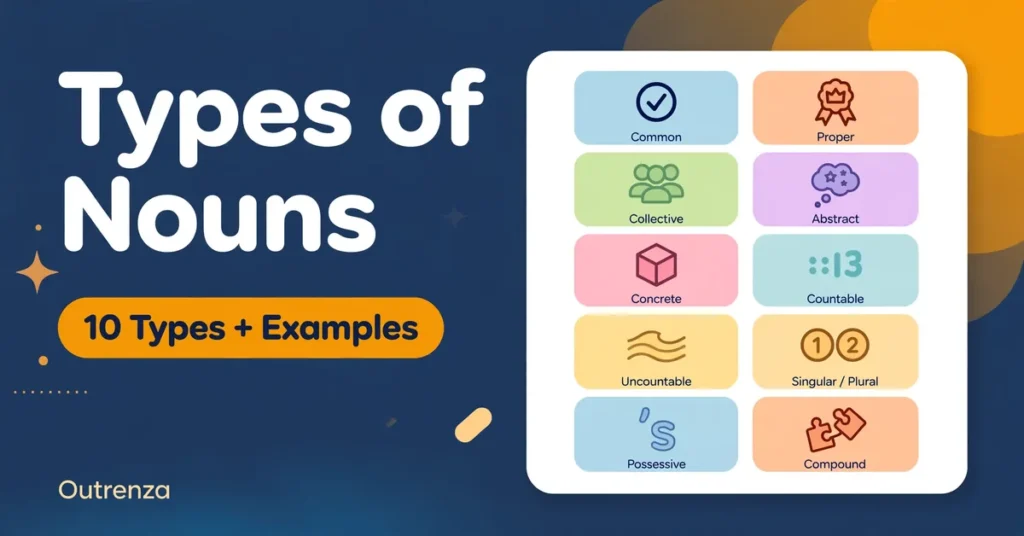
Quick answer: The 10 types of nouns are common nouns, proper nouns, collective nouns, abstract nouns, concrete nouns, countable nouns, uncountable nouns, singular and plural nouns, possessive nouns, and compound nouns. Scroll down to see each type explained with examples — or download the free Types of Nouns Chart to keep on your desk.
teacher, city, book
Ms. Johnson, California
team, flock, bunch
happiness, freedom
rainbow, thunder, pizza
apple → apples
water, advice, rice
cat → cats, child → children
dog’s bone
toothpaste, bus stop
One Rule to Sort Them All
Every noun names a person, place, thing, or idea. The 10 types are simply 10 ways of sorting those naming words — by whether they are general or specific, countable or uncountable, seen or only felt.
1. Common Nouns
Definition: A common noun names a general person, place, thing, or idea. It does not name anyone or anything specific.
Examples:
- Person: teacher, doctor, girl, neighbor
- Place: school, park, city, beach
- Thing: book, pencil, computer, pizza
- Idea: freedom, friendship
Teacher tip: Common nouns are the nouns kids learn first — usually in Grade 1. Notice that none of them are capitalized. If a child writes “Teacher gave me Homework,” that is the moment to introduce the next type on this list.
In a sentence:
- The teacher wrote on the board. (teacher and board are general — which teacher? which board?)
- A dog ran across the park.
2. Proper Nouns
Definition: A proper noun names a specific person, place, thing, or idea. Proper nouns are always capitalized.
Examples:
- Person: Ms. Johnson, Abraham Lincoln, Taylor Swift
- Place: Lincoln Elementary School, California, the Grand Canyon
- Thing: the Titanic, an iPhone, Harry Potter
- Days and months: Monday, July, Thanksgiving
In a sentence:
- Ms. Johnson teaches at Lincoln Elementary School.
- We visited the Grand Canyon in July.
Quick test for students: Cover the noun and ask, “Which one?” If the answer points to one specific person, place, or thing, you are looking at a proper noun.
Common mistake: Students often capitalize common nouns (“I love my Dog”) or forget to capitalize proper nouns (“we went to disneyland”). The rule is simple: specific = capital letter.
3. Collective Nouns
Definition: A collective noun names a group of people, animals, or things as one unit.
Examples:
- People: team, class, family, jury, crowd, staff
- Animals: pack (wolves), flock (birds), school (fish), herd (cattle), pride (lions)
- Things: bunch (grapes), set (tools), pile (leaves)
In a sentence:
- Our team won the game. (one team, many players)
- A flock of birds flew over the school.
- The jury reached a decision.
Teacher tip: Collective nouns for animals are a student favorite — and a great quiz topic. A “pack” of wolves, a “pride” of lions, a “school” of fish: kids remember these because they feel like secret code words.
Grammar note: In American English, collective nouns usually take a singular verb: “The team is winning.” (British English sometimes treats them as plural, but on this site we follow US usage.)
4. Abstract Nouns
Definition: An abstract noun names something you cannot see, hear, touch, smell, or taste — an idea, feeling, quality, or state.
Examples:
- Feelings: happiness, sadness, anger, love, fear
- Ideas: freedom, justice, knowledge, truth
- Qualities: kindness, honesty, courage, patience
- States: childhood, sleep, health
In a sentence:
- Happiness is more important than money.
- The soldiers fought for freedom.
- Patience helps you learn difficult things.
Teacher tip: Abstract nouns are usually introduced around Grade 5, because younger children think in concrete terms. A good classroom trick: “Can you put it in a box?” If the answer is no, it is probably abstract — you cannot box up kindness.
Watch out: Many abstract nouns are formed from adjectives or verbs by adding endings like -ness (kindness), -tion (celebration), or -ment (enjoyment). Spotting the ending is a useful skill for the worksheet exercises below.
5. Concrete Nouns
Definition: A concrete noun names something you can experience with your five senses — something you can see, hear, touch, smell, or taste.
Examples:
- See: rainbow, mountain, flag
- Hear: thunder, music, laughter
- Touch: pillow, sandpaper, ice
- Smell: perfume, smoke, cookies
- Taste: chocolate, lemonade, pizza
In a sentence:
- The rainbow appeared after the rain.
- I could hear the thunder from my bedroom.
Classroom activity: The abstract-vs.-concrete sort. Give students a mixed list of nouns (apple, love, chair, freedom, dog, honesty) and have them sort each word into two columns: “Can I touch it?” versus “Can I only think or feel it?” This single activity clears up more confusion than any lecture.
Connection: Concrete and abstract nouns are opposites — every noun is one or the other. When students can explain the difference, they are ready for harder grammar.
Mid-Point Check — Which Type Is It? A bunch of grapes · courage · Mrs. Patel · puppy
Answers: a bunch of grapes = collective noun · courage = abstract noun · Mrs. Patel = proper noun · puppy = common noun.
6. Countable Nouns
Definition: A countable noun is something you can count — it has a singular form and a plural form.
Examples:
- one apple → three apples
- one child → five children
- one idea → many ideas
How to spot them: Countable nouns work with numbers and with words like a/an, many, few, and several:
- a book, many friends, a few questions
7. Uncountable Nouns
Definition: An uncountable noun names something that cannot be counted as individual units — usually liquids, gases, materials, or abstract ideas. It has no plural form.
Examples:
- Liquids and gases: water, milk, juice, air, oxygen
- Materials: wood, glass, sand, rice, sugar
- Ideas and qualities: information, advice, homework, furniture, happiness
In a sentence:
- I need some water. (not “waters”)
- She gave me good advice. (not “advices”)
The classic mistake: Students — and even many adults — write “informations” or “furnitures.” The fix is to measure uncountable nouns with containers or amounts: a glass of water, a piece of advice, two bags of rice.
Quick test: If you can put a number directly in front of it (three apples ✓), it is countable. If you need a measuring word (three glasses of water), it is uncountable.
8. Singular and Plural Nouns
Definition: Singular nouns name one person, place, thing, or idea. Plural nouns name more than one.
Examples:
| Singular | Plural | Rule |
|---|---|---|
| cat | cats | add -s |
| box | boxes | add -es after s, x, ch, sh |
| baby | babies | change y to -ies |
| leaf | leaves | change f to -ves |
| child | children | irregular — just memorize it |
| tooth | teeth | irregular — just memorize it |
| sheep | sheep | same word, singular or plural |
| mouse | mice | irregular — just memorize it |
In a sentence:
- The cat sat on the mat. → The cats sat on the mat.
Teacher tip: Most plural errors come from just three patterns: words ending in y (baby → babies), words ending in f (leaf → leaves), and the irregular dozen (child → children, man → men, foot → feet). A singular and plural nouns worksheet that drills only these three patterns fixes 90% of mistakes.
9. Possessive Nouns
Definition: A possessive noun shows ownership — it tells us who or what something belongs to. Form it by adding ‘s or just an apostrophe.
Examples:
- the dog’s bone (the bone belongs to the dog)
- Sarah’s backpack
- the teachers’ lounge (the lounge belongs to the teachers — plural, so only an apostrophe)
- James’s hat or James’ hat (both are accepted in US schools; pick one and be consistent)
The rules, simply:
- Singular noun → add ‘s: the girl’s bike
- Plural noun ending in s → add only ‘: the girls’ bikes
- Plural noun not ending in s → add ‘s: the children’s toys
In a sentence:
- That is Maria’s pencil. Please give it back to her.
- The students’ projects are displayed in the hall.
Most common error: Confusing possessive nouns with plural nouns. “The dog’s are barking” is wrong — dog’s shows ownership; the plural is simply dogs. If you can replace the word with “belonging to,” the apostrophe belongs there.
10. Compound Nouns
Definition: A compound noun is made of two or more words joined together to name one person, place, thing, or idea.
The three forms:
- Closed (one word): bedroom, toothpaste, football, pancake
- Hyphenated: mother-in-law, well-being, merry-go-round
- Open (two words): ice cream, bus stop, high school, living room
In a sentence:
- I brushed my teeth with toothpaste in the bathroom.
- We met at the bus stop near the high school.
- My mother-in-law makes the best ice cream.
Fun fact for students: English creates new compound nouns all the time. Smartphone, website, and hashtag did not exist thirty years ago. Ask students to invent a compound noun for something in their classroom — it is a great creativity warm-up.
Spelling tip: There is no single rule for when a compound is closed, hyphenated, or open — when in doubt, check a dictionary. US dictionaries are the authority for American spelling (for example, email, not e-mail, in modern US usage).
Types of Nouns Chart
Here is the whole lesson on one page — save it, print it, or stick it on the classroom wall:
| # | Type | What it names | Example |
|---|---|---|---|
| 1 | Common noun | General person, place, thing, or idea | teacher, city, book |
| 2 | Proper noun | Specific name (always capitalized) | Ms. Johnson, California |
| 3 | Collective noun | A group as one unit | team, flock, bunch |
| 4 | Abstract noun | Idea or feeling (cannot touch) | happiness, freedom |
| 5 | Concrete noun | Thing you can sense | rainbow, thunder, pizza |
| 6 | Countable noun | Can be counted (singular + plural) | apple → apples |
| 7 | Uncountable noun | Cannot be counted (no plural) | water, advice, rice |
| 8 | Singular / Plural | One vs. more than one | cat → cats, child → children |
| 9 | Possessive noun | Shows ownership (‘s) | dog’s bone, teachers’ lounge |
| 10 | Compound noun | Two or more words joined | toothpaste, bus stop, mother-in-law |
One page, color-coded, perfect for binders and classroom walls.
Quick Practice — Name That Type!
Read each sentence. Which type is the bold noun?
- A flock of birds flew over the school.
- Kindness costs nothing.
- My sister lost her toothbrush.
- Please buy two bags of flour.
- The children’s toys are in Maria’s room.
Check your answers
1. flock — collective noun (a group as one unit) · 2. Kindness — abstract noun (a quality you cannot touch) · 3. toothbrush — compound noun (tooth + brush) · 4. flour — uncountable noun (you count bags of it, not “flours”) · 5. children’s — possessive noun (the toys belong to the children)
Common Mistakes Students Make (and How to Fix Them)
- Capitalizing common nouns. ❌ “My favorite Subject is Math.” → ✅ “My favorite subject is math.” (School subjects are common nouns — only languages and course names like “English” or “Algebra II” are capitalized.)
- Making uncountable nouns plural. ❌ “I have many homeworks.” → ✅ “I have a lot of homework.”
- Apostrophe confusion. ❌ “The dog’s are barking.” → ✅ “The dogs are barking.” / ✅ “The dog’s bone is here.”
- Forgetting that proper nouns need capitals everywhere — including in the middle of a sentence. ❌ “we visited paris.” → ✅ “We visited Paris.”
- Mixing up abstract and concrete. Happiness cannot go in a box; a puppy can. The “box test” from Section 4 never fails.
Practice: Free Worksheets and Quiz
Reading about nouns is the first step — using them is what makes the lesson stick. Try these next:
- 📝 Nouns Worksheet for Grade 1 — free printable with answers
- 📝 Noun Worksheets by Grade — free printable worksheets for Grades 1–8, each with an answer key
- 🎯 Take the Noun Quiz — 10 quick questions to test what you just learned
- 📘 What Is a Noun? — the pillar guide: the full definition, rules, and 100 examples
- 📋 Collective Nouns List — 150+ examples for animals, people, and things
Every noun names a person, place, thing, or idea — its type just tells you more about how it works.
General or specific? Count it or not? See it or only feel it? Those three questions sort almost every noun you will ever meet.
Frequently Asked Questions
The 10 types of nouns are common nouns, proper nouns, collective nouns, abstract nouns, concrete nouns, countable nouns, uncountable nouns, singular nouns, plural nouns, possessive nouns, and compound nouns. (Singular and plural are often taught as one pair, which is why some lists say “8 types” — the content is the same.)
A common noun names a general person, place, or thing (city, teacher, dog) and is not capitalized. A proper noun names a specific one (Chicago, Ms. Johnson, Buddy) and is always capitalized.
Five common abstract nouns are happiness, freedom, kindness, courage, and knowledge. You cannot see or touch them — you can only feel, think, or experience them.
Yes. Team is a collective noun because it names a group of people acting as one unit. Other examples include class, family, flock, and jury.
The dog’s bone — the apostrophe-s shows the bone belongs to the dog. For plural nouns ending in s, add only the apostrophe: the teachers’ lounge.
Start with common and proper nouns (the Grade 1–3 core), use the “box test” for abstract vs. concrete, and drill plurals with the three patterns (add -s/-es, y → -ies, irregulars). Then let students practice with a grade-level worksheet — short, focused practice beats long explanations at this age.
Irshad Ullah Asad is a linguist (M.Phil Linguistics) and content writer who has taught postgraduate classes for 15 years. At Outrenza, he turns deep expertise into simple, practical grammar lessons for teachers, parents, and students.

Founder & Editor, Outrenza. Irshad Ullah Asad is a linguist and experienced content writer with an M.Phil in Linguistics. For the past 15 years, he has taught postgraduate classes, helping advanced students master the structure and use of the English language. At Outrenza, he turns that deep expertise into simple, practical grammar lessons — clear explanations, rich examples, and free printable worksheets — so teachers, parents, and students can learn parts of speech and core grammar with confidence. His academic background in linguistics ensures that every lesson on Outrenza is accurate, well-structured, and easy to follow.