
Grades 2–4 • Common & Proper Nouns • About 15 minutes
You will learn: the one rule that tells common and proper nouns apart, every time.
Curriculum: Builds on US Grade 1 standard CCSS L.1.1.b (common and proper nouns) into Grade 2–3 capitalization.
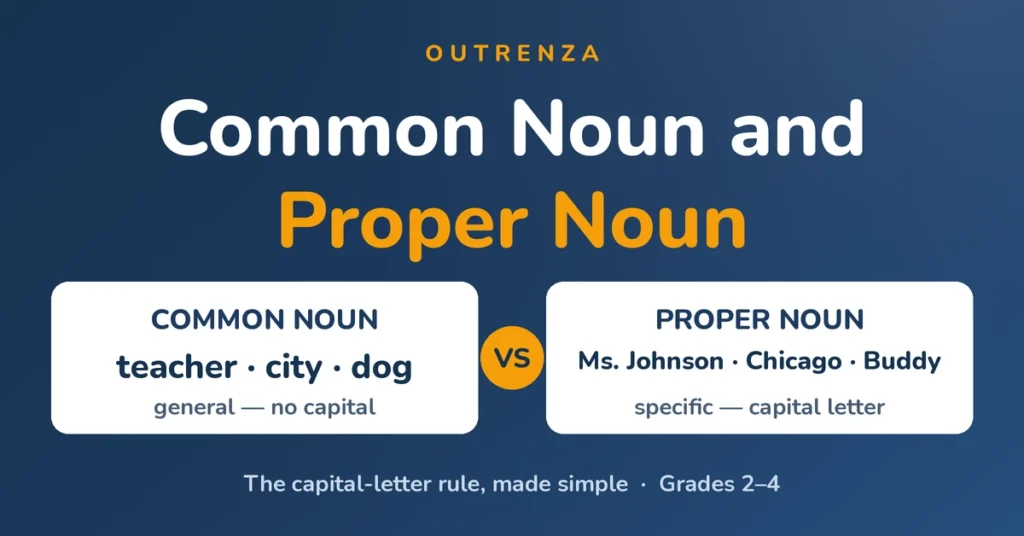
Quick answer: A common noun names a general person, place, thing, or idea — teacher, city, dog. A proper noun names a specific one — Ms. Johnson, Chicago, Buddy. The whole difference is one question: “Which one?” If the answer points to one specific name, capitalize it. If it could be any one of many, do not.
The Golden Rule
Specific = capital letter. General = small letter.
Every rule on this page is just this one rule, applied carefully.
Spot It: The One Question That Settles It
Teach this first, before any list. Point at a noun and ask: “Which one?”
- a teacher — which teacher? Any teacher. That is a common noun. No capital.
- Ms. Johnson — that teacher, the one we know. That is a proper noun. Capital M, capital J.
- a city — any city. Common.
- Chicago — that city. Proper.
Try it on the sentence every student knows: “The dog ran to the park.” Which dog? Any dog. Which park? Any park. Both common. Now change one word: “Buddy ran to Central Park.” Now we know exactly which dog and which park — both proper, both capitalized.
That is the Spot It step of the Outrenza lesson pattern: Rule first, then spot it in real sentences, then sort it, then use it yourself.
Sort It: Common vs Proper, Side by Side
| Common noun | Proper noun | |
|---|---|---|
| What it names | A general person, place, thing, or idea | One specific person, place, thing, or idea |
| Capital letter? | No — except at the start of a sentence | Yes — always, even in the middle of a sentence |
| Person | teacher, doctor, girl, neighbor | Ms. Johnson, Dr. Patel, Maya, Abraham Lincoln |
| Place | school, park, city, river | Lincoln Elementary School, Central Park, Chicago, Mississippi River |
| Thing | book, bicycle, dog, car | Harry Potter, Buddy, a Ford Mustang, the Titanic |
| Idea / time | holiday, month, language | Thanksgiving, July, English, Spanish |
| Test | “Which one?” → any one | “Which one?” → that one, by name |
PERSON
teacher → Ms. Johnson
PLACE
city → Chicago
THING
dog → Buddy
IDEA
holiday → Thanksgiving
Read the table one row at a time with students. The pattern never changes: the left column could be many things, the right column is one named thing.
The Capital-Letter Rules (All of Them, in One Place)
1. Proper nouns are always capitalized. Not just at the start of a sentence — anywhere. “We met Mr. Alvarez on Tuesday” has two capitals in the middle of the sentence, and both are correct.
2. Common nouns are capitalized only at the start of a sentence. “Dog” at the start of “Dogs bark” is capitalized because every sentence starts with a capital — not because dog became proper. Inside the sentence, it goes back to small: “The dog barked.”
3. Titles before a name are part of the proper noun. Ms. Johnson, Dr. Patel, President Lincoln, Aunt Rosa. But the job word alone is common: “The teacher smiled” and “The president spoke” take no capital.
4. Days, months, holidays, languages, and nationalities are proper nouns. Monday, July, Thanksgiving, English, Mexican food. Students often miss these because they do not look like names — but they name one specific day, language, or people.
5. Seasons are NOT capitalized. summer, winter, spring, fall are common nouns. This is the single most common over-capitalization in Grades 3-4: “I love Summer” is wrong; “I love summer” is right.
6. School subjects are common — except languages. math, science, history stay small. English, Spanish, French are capitalized because they are languages. “My favorite subject is math” but “My favorite subject is English.”
Tricky Cases Teachers Get Asked About
These are the cases where the “Which one?” question earns its keep:
- Mom and Dad. “I asked mom for help” (common — any mom, used as a job word) vs. “I asked Mom for help” (proper — used as her name, the way you would say Sarah). Same word, different job — the sentence decides.
- School vs. Lincoln Elementary School. “I go to school” is common. “I go to Lincoln Elementary School” is that school, by name — proper.
- River vs. Mississippi River. “A river runs past our town” is common. “The Mississippi River” is that river — proper.
- North vs. North America. Directions are common: “Drive north.” Regions and place names are proper: “North America,” “the South.”
- Apple vs. Apple. “I ate an apple” (the fruit, common). “I used an Apple laptop” (the company, proper). Same spelling, different meaning — context decides, exactly as with mom.
- The president vs. President Lincoln. The job alone is common; the job plus the name is proper.
Teacher tip: When a student asks “Is this one proper?”, do not answer. Ask back: “Which one?” If the class can point to one specific name, they have answered their own question — and they will remember it next time.
When a Name Acts Like a Common Noun
Sometimes a name stops naming just one person and starts doing a common noun’s job:
- Names can be plural. “There are two Mayas in our class.” “The Patels live next door.” A name takes -s like other nouns — and names ending in s, x, z, ch, or sh take -es: “the Joneses,” “the Martinezes.”
- A name can name a type. “He is a little Einstein” means he is very smart — the name now stands for a kind of person. You can even put a in front of it, just like a common noun.
- The name still keeps its capital letter, because it comes from one specific person. But in the sentence, its job is the common-noun job: it can follow a or the, and it can be plural.
Try It Now: Sort These Nouns
Sort each noun into Common or Proper. Answers are below, in the answer key.
- The girl read a book about Paris.
- Mr. Thompson teaches science on Fridays.
- Our dog loves summer, but Max hates the heat.
- We visited California in July and swam in the ocean.
- Mom made pizza for Thanksgiving.
Check your answers
1. girl — common; book — common; Paris — proper (that city). 2. Mr. Thompson — proper; science — common (a subject, not a language); Fridays — proper (a specific day). 3. dog — common; summer — common (seasons are not capitalized); Max — proper (that dog, by name). 4. California — proper; July — proper; ocean — common. 5. Mom — proper here (used as her name); pizza — common; Thanksgiving — proper (that holiday).
Use It: Turn Common Into Proper
Now write, do not just sort. Take each common noun and replace it with a proper noun of your own:
- a teacher → ________
- a city → ________
- a pet → ________
- a holiday → ________
Then write one sentence using all four of your proper nouns. This is the step that moves the rule from recognition to writing — and it is where the capital letters finally stick, because the student chose the names.
5 Mistakes Students Make (and How to Fix Them)
- Capitalizing common nouns. “My favorite Subject is Math.” → “My favorite subject is math.” Only languages and course names like “English” or “Algebra II” take capitals.
- Forgetting capitals on proper nouns mid-sentence. “we visited paris.” → “We visited Paris.” Proper nouns keep their capital everywhere.
- Capitalizing seasons. “I love Winter.” → “I love winter.”
- Capitalizing a job word without a name. “The Teacher gave us homework.” → “The teacher gave us homework.” Add the name and it changes: “Ms. Johnson gave us homework.”
- Calling every capitalized word proper. A capital at the start of a sentence proves nothing: “Dogs bark” still has a common noun. Check the middle of the sentence, not the start.
Quick Quiz: Common or Proper?
- Is Chicago a common or a proper noun?
- Is teacher a common or a proper noun?
- Which is correct: “I love Summer” or “I love summer“?
- In “Ask Mom,” is Mom common or proper — and why?
- Fix this sentence: “my brother tom visited texas in july.”
Quiz answers
1. Proper — that city, by name. 2. Common — any teacher. 3. “I love summer” — seasons are common. 4. Proper — it is used as her name. 5. “My brother Tom visited Texas in July.” (Sentence-start capital plus three proper nouns.)
Frequently Asked Questions
A common noun names a general person, place, thing, or idea (city, teacher, dog) and is not capitalized. A proper noun names one specific person, place, thing, or idea (Chicago, Ms. Johnson, Buddy) and is always capitalized.
Yes. Days of the week name one specific day, so they are proper nouns and always capitalized — just like months (July) and holidays (Thanksgiving).
When mom is used as a name (“Ask Mom”), it is proper. When it is used as an ordinary word (“I asked my mom”), it is common. The sentence, not the spelling, decides.
No. Spring, summer, fall, and winter are common nouns and stay in small letters, unlike months and holidays.
Yes — languages are proper nouns. That is why English is capitalized while other school subjects (math, science, history) are not.
Yes. Park is common; Central Park is proper. Apple the fruit is common; Apple the company is proper. Ask “Which one?” — if the answer is one specific thing by name, it is proper.
Yes. Names form plurals like other nouns: two Mayas, the Patels, the Joneses.
Keep Learning: Your Next Steps
- 📘 Types of Nouns: Definition, Examples, and Worksheets — the complete hub: all 10 types, including common and proper, with a printable chart.
- 📘 What Is a Noun? — the pillar guide: the full definition, the three noun tests, and 100+ examples.
- 📝 Nouns Worksheet for Grade 1 — Free Printable with Answers — practice now with the live worksheet: circle, sort, and fill in nouns, with a complete answer key.
- 📝 Common and Proper Nouns Worksheet for Grade 3 — Free Printable with Answers

Founder & Editor, Outrenza. Irshad Ullah Asad is a linguist and experienced content writer with an M.Phil in Linguistics. For the past 15 years, he has taught postgraduate classes, helping advanced students master the structure and use of the English language. At Outrenza, he turns that deep expertise into simple, practical grammar lessons — clear explanations, rich examples, and free printable worksheets — so teachers, parents, and students can learn parts of speech and core grammar with confidence. His academic background in linguistics ensures that every lesson on Outrenza is accurate, well-structured, and easy to follow.
Pingback: Collective Nouns: Definition, Examples, and a Big List for Kids