
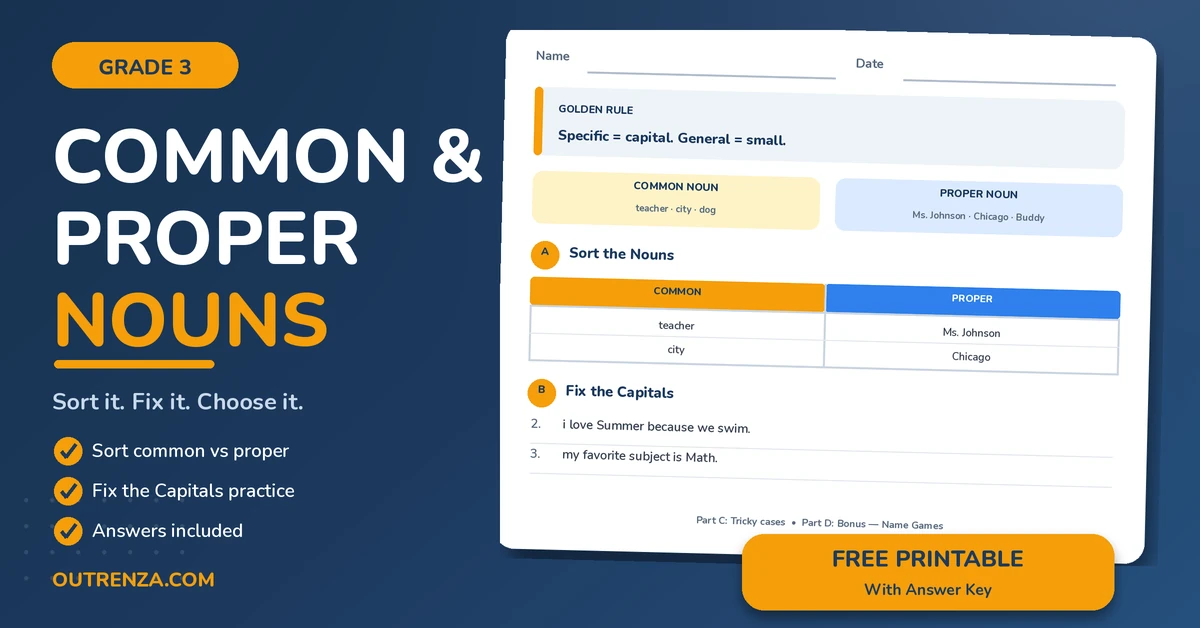
Grade 3 • Common & Proper Nouns • About 20 minutes
You will learn to: sort common and proper nouns • fix capitals • beat the tricky cases • try a bonus name game
Includes: 4 activities • a free printable PDF • a teacher guide • a full answer key
Curriculum: Builds on CCSS L.1.1.b (common and proper nouns) and L.2.2a (capitalizing holidays, product names, and geographic names); supports Grade 3 capitalization conventions, CCSS L.3.2.
The Golden Rule
Specific = capital letter. General = small letter.
A common noun names a general person, place, thing, or idea — teacher, city, dog. A proper noun names a specific one — Ms. Johnson, Chicago, Buddy. This free worksheet practices that one rule four ways: sort it, fix it, choose it, stretch it. Full answer key included — about 20 minutes.
First, a Quick Refresher
Ask one question about any noun: “Which one?” Any one of many → common, no capital. That one, by name → proper, always a capital. (New to nouns? Start with What Is a Noun?; the full guide is Common Noun and Proper Noun.)
| Common noun | Proper noun | |
|---|---|---|
| What it names | A general person, place, thing, or idea | One specific one, by name |
| Capital letter? | No — except at the start of a sentence | Yes — always, everywhere |
| Person | teacher | Ms. Johnson |
| Place | city | Chicago |
| Thing | dog | Buddy |
| Idea / time | holiday | Thanksgiving |
PERSON
teacher → Ms. Johnson
PLACE
city → Chicago
THING
dog → Buddy
IDEA
holiday → Thanksgiving
How to Use This Worksheet
- Print it, or work on screen. Each part works alone — Parts A and B today, the rest tomorrow.
- Say “Which one?” out loud. It settles almost every capital on this page.
- Part D is a bonus. Harder on purpose — skip it, save it, or try it together.
- Check with the answer key. Finish a whole part first, then check together.
For Teachers: Using This Worksheet in Class
Before you start (2–3 minutes)
- Write the Golden Rule on the board: Specific = capital letter. General = small letter.
- Ask “Which one?” about one pair — city / Chicago — then point to Part B, Question 1: already worked.
You need: one printed sheet per child (PDF pages 1–2) and a pencil.
Timing (about 20 minutes): teach 4 • Parts A–C 11 • check together 5. Part D runs on its own for fast finishers.
Support (for students who need a step up): keep the refresher table visible, do Part A in pairs, say “Which one?” to a partner first.
Challenge (for fast finishers): Part D — plural names and “a little Einstein,” the Grade 4–5 stretch.
Quick check before they leave: each student turns one common noun into a proper one: “river — Mississippi River.” Ten seconds each shows who owns the rule.
Homework: send pages 1–2 home; keep the key (page 3) and this guide (page 4) at school.
Part A — Sort It: Common or Proper?
Write each word from the bank in the right row and column of the grid.
Word bank: teacher • Ms. Johnson • city • Chicago • dog • Buddy • holiday • Thanksgiving • river • Mississippi River • month • July • girl • Maya • school • Lincoln Elementary School
| Common Noun | Proper Noun | |
|---|---|---|
| Person | ||
| Place | ||
| Thing | ||
| Idea / Time |
Hint: every row holds exactly two common and two proper nouns. Count as you go!
Part B — Fix the Capitals
Rewrite each sentence with the capitals fixed — some are missing, and some are there by mistake. The first one is done for you.
- (done for you) our teacher ms. johnson took us to the park. → Our teacher Ms. Johnson took us to the park.
- i love Summer because we swim every day.
- my favorite subject is Math, but my sister likes english best.
- The Teacher gave a Book to liam on monday.
- We visited the grand canyon in arizona last Spring.
- dr. patel speaks spanish and works at our School.
- In december, our class read a story about the titanic.
- My friend sara moved to texas, but she misses the mississippi river.
Hint: the classic traps — seasons and subjects stay small (languages excepted), and job words stay small until a name joins them.
Part C — Tricky Cases: You Choose
Circle the right choice in each sentence. The same word can change its answer — the sentence decides!
- “Can I have a cookie, (Mom / mom)?”
- My (Mom / mom) drives me to school.
- I walk to (school / School) every day.
- I go to (lincoln elementary school / Lincoln Elementary School).
- A (river / River) runs behind our town.
- We crossed the (mississippi river / Mississippi River) on a bridge.
- I ate an (apple / Apple) for lunch.
- My new tablet was made by (apple / Apple).
Talk it over: Questions 1 and 2 give one word two answers — mom as a name is proper; as a job word, common.
Bonus Challenge — Part D: Name Games
A stretch — teachers and older kids, jump in too! Sometimes a name does a common noun’s job: it can be plural and follow a or the — but it keeps its capital.
Finish each sentence. The name you need is in brackets.
- There are two ______ in our class. (Maya)
- The ______ live next door to us. (Patel family)
- All the ______ came to the party. (Jones family)
- The ______ moved to Texas last year. (Martinez family)
- Ben can fix any toy in the class. He is a little ______! (Einstein)
- Two ______ in the story both wanted the same name. (Emma)
The secret: names take -s like other nouns — two Mayas, the Patels. Names ending in s, x, z, ch, or sh take -es — the Joneses, the Martinezes.
Notes for Teachers and Grown-Ups
- One part at a time is fine. Parts A and B make one session; Parts C and D make another.
- Part B, Question 1 is worked. Study it first — it shows what “fixed” looks like.
- The traps are the teaching. Seasons, subjects, and job words are where Grade 3 writers lose the most capitals. Missed one? Ask “Which one?” first.
- Part C has sentence questions, not trick questions. Mom is proper in Question 1, common in Question 2 — the sentence decides.
- Part D is optional and ungraded. It previews Grades 4–5 name use; trying beats acing.
- Choosing counts more than spelling. A well-placed capital with shaky spelling is still the skill.
Wrong vs Right: 4 Mistakes Grade 3 Kids Often Make
Mistake 1 — Capitalizing seasons
❌ Wrong: “I love Summer.”
✅ Right: “I love summer.” Seasons are common — unlike days, months, and holidays.
Mistake 2 — Capitalizing school subjects
❌ Wrong: “My best Subject is Math.”
✅ Right: “My best subject is math.” Subjects stay small; languages (English, Spanish) are proper.
Mistake 3 — Dropping capitals mid-sentence
❌ Wrong: “we saw maya in chicago.”
✅ Right: “We saw Maya in Chicago.” Proper nouns keep capitals everywhere, not just at the start.
Mistake 4 — Capitalizing a job word with no name
❌ Wrong: “The Teacher called my name.”
✅ Right: “The teacher called my name.” A job word alone is common; with a name it turns proper: “Ms. Johnson called my name.”
Answer Key
Check Answers — Answer Key (for grown-ups)
Part A — Sort It
| Common Noun | Proper Noun | |
|---|---|---|
| Person | teacher, girl | Ms. Johnson, Maya |
| Place | city, school | Chicago, Lincoln Elementary School |
| Thing | dog, river | Buddy, Mississippi River |
| Idea / Time | holiday, month | Thanksgiving, July |
Sorting note: “river” is the general word, so it sits with the things; “Mississippi River” names one river — proper.
Part B — Fix the Capitals
- Our teacher Ms. Johnson took us to the park. (teacher = job word, small; Ms. Johnson proper)
- I love summer because we swim every day. (summer = season, common)
- My favorite subject is math, but my sister likes English best. (subject, math small; English = language, proper)
- The teacher gave a book to Liam on Monday. (teacher, book small; Liam, Monday proper)
- We visited the Grand Canyon in Arizona last spring. (spring = season, common)
- Dr. Patel speaks Spanish and works at our school. (school common here — no name)
- In December, our class read a story about the Titanic. (December, Titanic proper)
- My friend Sara moved to Texas, but she misses the Mississippi River. (all three names proper)
Part C — Tricky Cases
- Mom — used as her name, like Sara. Proper.
- mom — a job word here (“my mom”). Common.
- school — any school, in general. Common.
- Lincoln Elementary School — that school, by name. Proper.
- river — any river. Common.
- Mississippi River — that river, by name. Proper.
- apple — the fruit. Common.
- Apple — the company. Proper.
Bonus Challenge — Part D: Name Games
- Mayas — “two Mayas.” Names take -s for more than one person with that name.
- Patels — “the Patels” = the whole Patel family. Plain -s.
- Joneses — Jones ends in s, so it takes -es.
- Martinezes — Martinez ends in z, so it takes -es.
- Einstein — “a little Einstein” = a very smart person. The name does a common noun’s job (it follows a) but keeps its capital.
- Emmas — “two Emmas.” Plain -s, like Mayas.
Key note: plural names keep their capital. Names ending in s, x, z, ch, or sh add -es; all others add -s.
Check Yourself: I Can…
Checked your answers? Tick each box that is true for you:
☐ I can sort nouns into common and proper.
☐ I can fix the capital letters in a sentence.
☐ I can decide the tricky cases — the sentence tells me!
☐ I tried the bonus name games with plurals like Mayas and Joneses.
How did it feel? 😀 I did it! 🙂 Almost — one more try. 🌱 I need more practice.
My favorite proper noun today: ___
Remember: Specific Gets the Capital
Specific = capital letter. General = small letter.
- Common: teacher, city, dog, holiday
- Proper: Ms. Johnson, Chicago, Buddy, Thanksgiving
Stuck? Ask: “Which one?” One specific name → capital.
Lesson Path: Keep Learning
Step 1 — Learn it: Common Noun and Proper Noun — the full guide to the capital-letter rule
Step 2 — Practice it: Common and Proper Nouns Worksheet for Grade 3 (you are here)
Step 3 — Grow it: Types of Nouns — all 10 noun types, with a printable chart
Frequently Asked Questions
A common noun names a general person, place, thing, or idea (teacher, city, dog) and is not capitalized. A proper noun names one specific one (Ms. Johnson, Chicago, Buddy) and always is.
No. Spring, summer, fall, and winter are common nouns and stay small. Days (Monday), months (July), and holidays (Thanksgiving) are proper.
Languages are proper nouns (English, Spanish). Other subjects (math, science, history) are common and stay small.
Yes: two Mayas, the Patels. Names ending in s, x, z, ch, or sh add -es: the Joneses, the Martinezes. The capital stays.
About 20 minutes. Parts A and B are the core; Part C is for discussion, Part D an optional bonus.
Yes. The PDF is free, key and teacher guide included — no email required. Teachers may print it freely; for homework, send pages 1–2 home and keep the key at school.
Download the Free Printable
Keep Learning: Your Next Steps
- 📘 Common Noun and Proper Noun: Difference, Examples, and Worksheet — the guide this worksheet practices, with the name games behind Part D.
- 📗 What Is a Noun? — the pillar guide: definition, three noun tests, 100+ examples.
- 📘 Types of Nouns: Definition, Examples, and Worksheets for Kids — the hub: all 10 noun types, with a printable chart.
- 📝 Nouns Worksheet for Grade 1 — Free Printable with Answers — a gentler starter: circle, sort, and fill in nouns.

Founder & Editor, Outrenza. Irshad Ullah Asad is a linguist and experienced content writer with an M.Phil in Linguistics. For the past 15 years, he has taught postgraduate classes, helping advanced students master the structure and use of the English language. At Outrenza, he turns that deep expertise into simple, practical grammar lessons — clear explanations, rich examples, and free printable worksheets — so teachers, parents, and students can learn parts of speech and core grammar with confidence. His academic background in linguistics ensures that every lesson on Outrenza is accurate, well-structured, and easy to follow.