
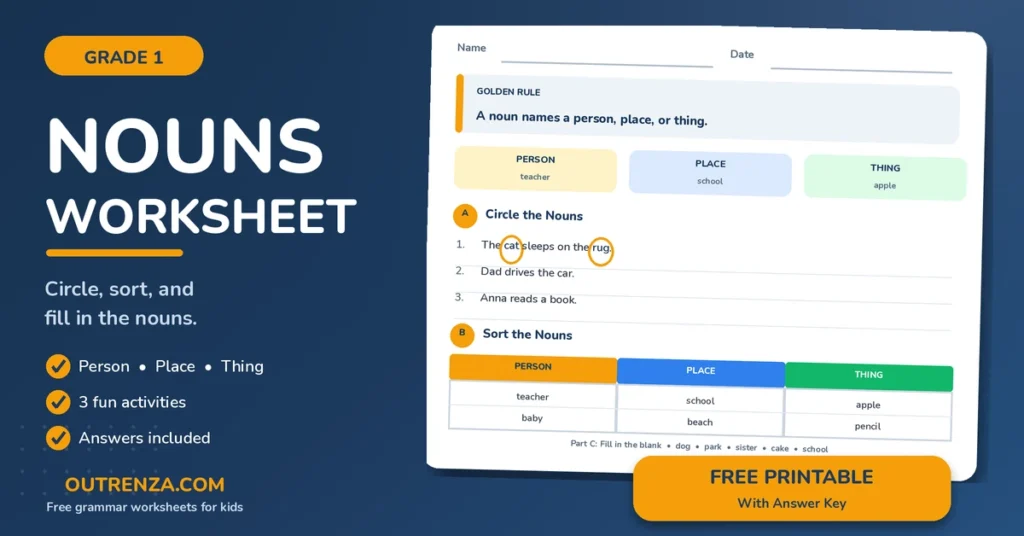
Grade 1 • Nouns • About 15 minutes
You will learn to: name a person, place, and thing • circle nouns in sentences • sort nouns into groups • choose a noun to finish a sentence
Includes: 3 practice activities • a bonus noun hunt • a free printable PDF • a teacher guide • a full answer key for grown-ups
Curriculum: Fits US Grade 1 language standard CCSS L.1.1.b (nouns — common and proper) and similar state Grade 1 standards.
Golden Rule — Quick Answer
A noun is a naming word. It names a person, a place, or a thing.
This free nouns worksheet for Grade 1 gives your child three short, fun tasks: circle the nouns, sort nouns into person, place, and thing, and fill in the blank with a noun. Every task comes with an answer key, so a parent or teacher can check it in one minute. It takes about 15 minutes, and it works best for first graders who already know that a noun names a person, place, or thing.
Grade 1 Reminder: A Noun Names a Person, Place, or Thing
PERSON
mom, teacher
PLACE
school, park
THING
dog, apple, book
Teacher tip: In Grade 1, we keep it to person, place, and thing. Animals like dog and cat count as things here, because they are living things a child can see and touch. The idea sense of nouns (love, joy) comes in later grades.
New to nouns? Start with What Is a Noun? Definition, Examples, and Easy Rules for Kids. For the full family of noun types, see Types of Nouns: Definition, Examples, and Worksheets for Kids.
How to Use This Worksheet
- Print it, or just read it on screen. Each part works on its own, so you can do one part today and save the rest for tomorrow.
- Read the words out loud together. Grade 1 is still a reading year, so say each sentence slowly and let your child point to the noun.
- Do not worry about perfect spelling. If your child circles the right word, that is a win, even if the handwriting is wobbly.
- Check with the answer key at the end. Keep the key away from your child while they work, then check together.
For Teachers: Using This Worksheet in Class
Before you start (2–3 minutes)
Write the Golden Rule on the board: A noun names a person, a place, or a thing. Ask for one quick example of each kind from the class, then point to Part A, Question 1 — it is already worked as an example (both cat and rug are circled).
You need: one printed sheet per child (or the page on a projector), a pencil, and crayons if you use the Bonus Challenge drawing.
Timing (about 15 minutes): teach 3 minutes • Parts A–C 8 minutes • check together 4 minutes.
Support (for children who need a step up): read each sentence aloud, let them point before they circle, and allow Part A only today. The word cards at the top of the page stay visible as a hint.
Challenge (for fast finishers): send them to the Bonus Challenge — write one sentence of their own and circle its nouns.
Quick check before they leave: ask each child to say one noun and its kind — “dog — thing.” Ten seconds per child tells you who has it and who needs Part A again tomorrow.
Homework: send home the printable page only, and keep the answer key at school.
Part A — Spot It: Circle the Nouns
Circle every naming word you can find in each sentence. Most lines hold two nouns — a person and a thing — and finding either one counts.
- The cat sleeps on the rug. (bold “cat” — it is the worked example)
- Dad drives the car.
- We play at the park.
- Anna reads a book.
- The bird sings a song.
- Mom bakes a cake.
- Sam kicks the ball.
- The fish swims in the pond.
Hint for grown-ups: in Part A, the first sentence is done as an example. If your child is stuck, ask, “Who or what is this sentence about?”
Part B — Sort It: Person, Place, or Thing?
Write each word in the right box: Person, Place, or Thing.
Words: teacher, school, apple, baby, beach, pencil, farmer, zoo
| Person | Place | Thing |
|---|---|---|
Sorting note: “zoo” is a place you visit, so it goes in Place — if your child puts it in Thing, talk it over rather than marking it wrong: it is a place with things in it. The full sorted table is in the answer key below.
Part C — Use It: Fill in the Blank with a Noun
Choose a noun from the box to finish each sentence. Any sensible noun earns full marks — the key gives one good answer each time.
Box: dog, park, sister, cake, school
- My ___ reads to me at night.
- We run and play at the ___.
- The ___ barks at the mailman.
- I eat ___ on my birthday.
- I learn to read at ___.
Bonus Challenge — Noun Hunt
Finished fast? Go on a noun hunt, at school or at home. Find one of each kind, and write it or draw it:
- A person I can see: ___
- A place I can go to: ___
- A thing I can hold: ___
Super challenge: write one sentence with your three nouns, then circle each noun yourself.
Notes for Teachers and Grown-Ups
- One part at a time is fine. Each part works on its own. Part A today and Parts B and C tomorrow is a good plan for a tired first grader.
- Reading support helps. Grade 1 is still a reading year, so read each sentence out loud and let your child point to the noun.
- Spelling is not the test. The skill here is spotting naming words. Wobbly handwriting still earns the mark.
- Keep the answer key aside. Let your child finish first, then open the key below and check together.
- In Part A, either correct noun counts. Young sentences often hold two nouns. If your child circles either one, count it right and praise it.
- Talk through “zoo” in Part B. Zoo is a place you visit, so it belongs in Place, but a child who sorts it as a Thing is reasoning well. Confidence matters more than one box.
Wrong vs Right: 3 Mistakes Grade 1 Kids Often Make
Mistake 1 — Circling an action word
Wrong: Run, jump, and sing treated as nouns.
Right: Those are verbs, not nouns. Ask: “Can I point to it, or is it something someone does?”
Mistake 2 — Missing names
Wrong: Skipping Anna, Sam, and Mom because they are “just names.”
Right: Names are nouns too — they are names of people. Names of people and places start with a capital letter.
Mistake 3 — Forgetting places
Wrong: Skipping park, school, and zoo because you cannot hold them.
Right: They are nouns, even though you cannot hold them in your hand. A place is still a naming word.
Answer Key
Check Answers — Answer Key (for grown-ups)
Part A — Spot It:
- cat, rug (both are circled in the example)
- Dad, car — accept either, but the target is car as the thing noun; Dad is also a person noun, so praise both
- park
- Anna, book — accept both
- bird, song
- Mom, cake
- Sam, ball
- fish, pond
Honest note for the checker: young sentences often hold two nouns (a person and a thing). If your child circles either correct noun, count it right. The skill being tested is spotting naming words, not picking one “only” answer.
Part B — Sort It: Person: teacher, baby, farmer | Place: school, beach, zoo | Thing: apple, pencil
Part C — Use It: 1. sister 2. park 3. dog 4. cake 5. school
Bonus Challenge — Noun Hunt: any real person, place, and thing the child can name or draw earns full marks. In the super challenge, check that the child circled the nouns they used — the words themselves will be different for every child, and that is the point.

Check Yourself: I Can…
Now that you have checked your answers, tick each box that is true for you:
☐ I can name a person, a place, and a thing.
☐ I can circle the nouns in a sentence.
☐ I can sort nouns into person, place, and thing.
☐ I can pick a noun to finish a sentence.
How did it feel? 😀 I did it! 🙂 Almost — one more try. 🌱 I need more practice.
My favorite noun today: ___
Remember: Nouns Name People, Places, and Things
A noun is a naming word.
Person: teacher • Place: school • Thing: apple
Stuck on a word? Ask: “Who or what does this word name?” If it names a person, place, or thing, it is a noun.
Lesson Path: Keep Learning
Step 1 — Learn it: What Is a Noun? — the full rules in simple words
Step 2 — Practice it: Nouns Worksheet for Grade 1 (you are here)
Step 3 — Grow it: Types of Nouns — common, proper, collective nouns, and more, when your child is ready
Frequently Asked Questions
A noun is a naming word. It names a person (teacher), a place (school), or a thing (apple). Grade 1 keeps it that simple.
About 15 minutes. If it takes longer, split it: Part A today, Parts B and C tomorrow. Short and happy beats long and tired.
Yes. The printable PDF is free, and the answer key is included. No email is required to use the worksheet on this page.
Yes. Teachers may print it for classroom use. For homework, send the worksheet page home and keep the answer key.
Action words (verbs) come next in most Grade 1 programs: what a person or thing does. A child who can spot nouns first learns verbs much faster.
No. The goal at this age is sorting by meaning, and zoo can be argued both ways. Talk about why it is a place, and move on. Confidence matters more than one box.
Download the Free Printable
Done with this one? Go back to What Is a Noun? for the full rules, or try the Types of Nouns guide when your child is ready for common, proper, and collective nouns.

Founder & Editor, Outrenza. Irshad Ullah Asad is a linguist and experienced content writer with an M.Phil in Linguistics. For the past 15 years, he has taught postgraduate classes, helping advanced students master the structure and use of the English language. At Outrenza, he turns that deep expertise into simple, practical grammar lessons — clear explanations, rich examples, and free printable worksheets — so teachers, parents, and students can learn parts of speech and core grammar with confidence. His academic background in linguistics ensures that every lesson on Outrenza is accurate, well-structured, and easy to follow.