
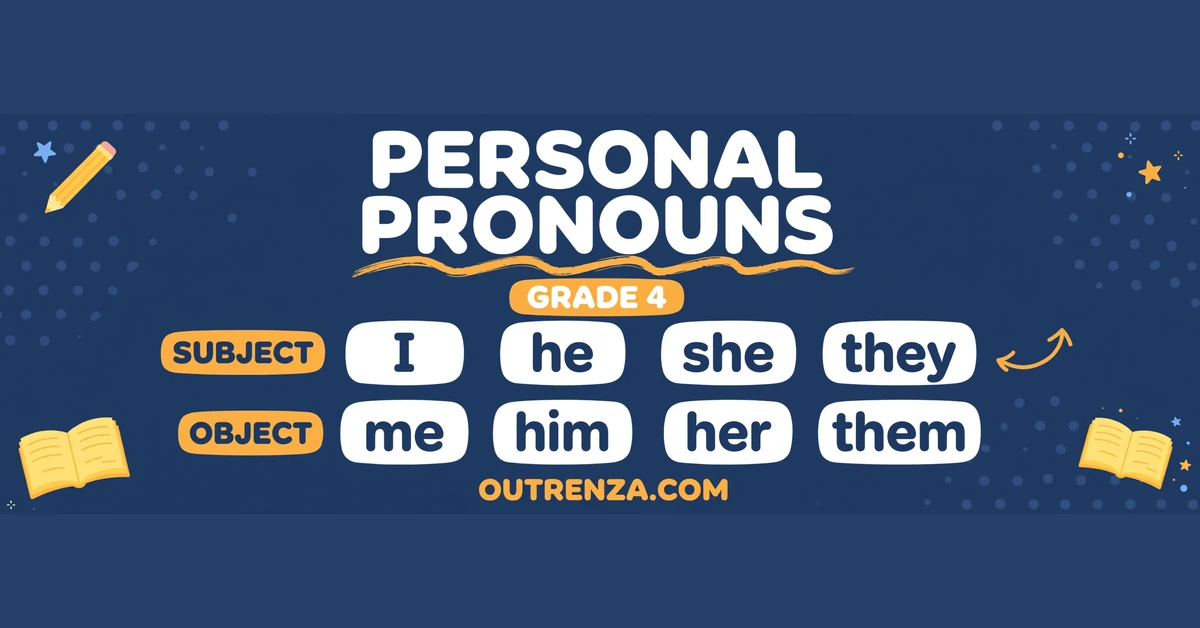
Grade 4 • Personal Pronouns • About 20 minutes
You will learn to: tell subject forms from object forms • use the swap test • pick the right form after little words like to and between
Includes: 2 pronoun sets • a pairs table • 3 practice rounds • a bonus rescue • a full answer key
Curriculum: Builds on CCSS L.1.1.d (personal and possessive pronouns); supports L.3.1a (the function of pronouns in particular sentences).
Quick answer: Personal pronouns are the little words that stand in for people and things: I, you, he, she, it, we, they. Every one has two forms. The subject form does the action — I, he, they. The object form receives the action — me, him, them. The job in the sentence picks the form.
The Job Picks the Form
A pronoun changes its shape to match its job. Doing the action? Use the subject form: She kicked the ball. Receiving the action, or following a little word like to, for, with, or between? Use the object form: The ball rolled to her. Same person — two costumes.
Think about how often you say a name. Leo kicked the ball to Maya, and Maya passed the ball back to Leo. Names get heavy fast, so English swaps in stand-ins — and once those stand-ins arrive, they have to dress for the job. This page teaches personal pronouns by their two jobs: the form that acts, and the form that gets acted on. (It helps to spot the nouns first: Identifying Nouns shows how, and What Is a Noun? covers the naming rule.)
What Are Personal Pronouns?
Personal pronouns point to a specific person or thing without using a name. I points to the speaker, you to the listener, he, she, and it to someone or something else, and we and they to groups. None of them names anybody — naming is the noun’s job — but each one changes shape when its job changes. One set works at the front of the action; the other set works everywhere else.
The doers — they run the action.
I, you, he, she, it, we, they
The receivers — the action lands on them.
me, you, him, her, it, us, them
SUBJECT SET (THE DOERS)
I, you, he, she, it, we, they
OBJECT SET (THE RECEIVERS)
me, you, him, her, it, us, them
Look closely and you will spot two cheaters: you and it wear the same costume for both jobs. Everyone else changes: I becomes me, he becomes him, she becomes her, we becomes us, they becomes them.
Every pair, side by side:
| Who it points to | Subject form (does the action) | Object form (receives it) |
|---|---|---|
| the speaker | I | me |
| the listener | you | you |
| a man or boy | he | him |
| a woman or girl | she | her |
| a thing or animal | it | it |
| the speaker + others | we | us |
| a group | they | them |
The Swap Test: Drop the Other Person
Sentences love to travel in pairs — Sara and I, him and me — and pairs are where the wrong form sneaks in. The swap test catches it every time: cover up the partner, and say the sentence with your pronoun alone. Your ear will vote for the right form.
- “Me and Sara went to the library.” Drop Sara → “Me went to the library.” ✘ Your ear says no. Swap in the subject form: “I went” ✔ → Sara and I went to the library.
- “The coach praised Ben and I.” Drop Ben → “The coach praised I.” ✘ This is an object job, so the object form wins: “praised me” ✔ → The coach praised Ben and me.
- “Him and me built the fort.” Test each one alone → “Him built” ✘, “Me built” ✘. Both are object forms doing a subject job → He and I built the fort.
One kindness rule rides along: it is polite to put your partner first — Sara and I, not I and Sara. But politeness never changes the form. The swap test decides the form; manners decide the order.
After Little Words, the Object Set Steps In
Words like to, for, with, from, and between are prepositions — little direction words. A pronoun that follows one always takes the object form, even when a partner comes along for the ride: Give it to me. This gift is for us. Come with them. Keep it between you and me.
That last one is the most famous trap in English. “Between you and I” sounds fancy, but between is a preposition, so the object form wins: between you and me. Run the swap test if you doubt it — “between I” ✘, “between me” ✔.
Practice Rounds: Using Personal Pronouns
Three rounds, one per skill. Finish a whole round before peeking at the key.
Round 1 — Pick the Subject Form. Circle the form that does the action. 1. ( I / Me ) built a tall tower of blocks. 2. ( They / Them ) are coming to lunch today. 3. ( He / Him ) rides the bus to school. 4. ( We / Us ) planted seeds in the garden. 5. ( She / Her ) sings in the school choir. 6. Ben and ( I / me ) share the markers. 7. Dad and ( we / us ) fixed the fence on Saturday. 8. ( He / Him ) and Rosa led the line to art class.
Round 2 — Pick the Object Form. Circle the form that receives the action — or follows a little word like to, for, or between. 1. The teacher called ( I / me ) to the board. 2. Please give the note to ( she / her ). 3. We waved at ( they / them ) from the bus. 4. Grandma baked cookies for ( we / us ). 5. The puppy followed ( he / him ) all the way home. 6. Our neighbor thanked ( she / her ) for the help. 7. The coach picked ( they / them ) first for the relay. 8. Between you and ( I / me ), that test was tricky.
Round 3 — Fix It With the Swap Test. Each sentence hides a wrong form — one of them hides two. Rewrite each sentence correctly. 1. Me and Jayden built a fort. 2. The trophy went to Ana and I. 3. Him and me raced to the fence. 4. Grandma took we to the zoo. 5. Between you and I, this pizza is the best in town.
Bonus — Pronoun Rescue. This paragraph repeats its names until it creaks. Rewrite it, swapping in pronouns wherever they fit: “Maya found a lost puppy. Maya took the puppy to Ms. Chen. Ms. Chen phoned the owner, and the owner thanked Maya and Ms. Chen.”
Answer Key
Check Answers — Full Answer Key (for grown-ups)
Round 1 — Pick the Subject Form
1. I — the speaker does the action. 2. They. 3. He. 4. We. 5. She. 6. I — drop Ben: “I share the markers.” 7. we — drop Dad: “we fixed the fence.” 8. He.
Round 2 — Pick the Object Form
1. me — called to the board; me receives. 2. her — after to. 3. them — after at. 4. us — after for. 5. him. 6. her. 7. them. 8. me — after between.
Round 3 — Fix It With the Swap Test
1. Jayden and I built a fort. (“Me built” fails alone.) 2. The trophy went to Ana and me. (“went to I” fails.) 3. He and I raced to the fence. (Both forms were wrong.) 4. Grandma took us to the zoo. 5. Between you and me, this pizza is the best in town.
Bonus — Pronoun Rescue (one good rescue)
“Maya found a lost puppy. She took it to Ms. Chen. She phoned the owner, and the owner thanked them.” Accept any clear rewrite — but watch the second she: it points to Ms. Chen now. If a pronoun makes the sentence muddy, keeping the name is the smarter rescue.
For Teachers: Running the Practice in Class
Before you start (2 minutes)
- Write the two sets on the board in pairs: I–me, he–him, she–her, we–us, they–them; circle you and it as the “no-change” pair.
- Model the swap test once, thinking aloud: cover the partner, listen to your ear, then uncover.
You need: the rounds above on screen or printed; a pencil per child.
Timing (about 20 minutes): sets and table 4 • swap test 3 • little-words rule 2 • Rounds 1–2 6 • Round 3 + Bonus 3 • check together 2.
Support: partners read each sentence twice — once with each form — pick the one that sounds right, then say why it wins.
Challenge: the Bonus paragraph — the second she is the trap; strong writers keep a name when a pronoun would confuse.
Quick check: call a frame — “The prize went to Ben and ___” — students answer me and explain it with the swap test.
Wrong vs Right: 4 Traps That Catch Pronoun Users
Trap 1 — Object forms doing the action
❌ Wrong: “Me and him went to the store.” ✅ Right: “He and I went to the store.” Swap-test both: “Me went” ✘ and “Him went” ✘ — both were object forms on a subject job.
Trap 2 — The fancy “and I”
❌ Wrong: “The award went to Sara and I.” ✅ Right: “The award went to Sara and me.” The pair receives the award. Drop Sara: “went to I” fails the ear test every time.
Trap 3 — Between you and I
❌ Wrong: “Keep it between you and I.” ✅ Right: “Keep it between you and me.” Between is a preposition, and a preposition always takes the object form — fancy is not the same as correct.
Trap 4 — “Us” as a doer
❌ Wrong: “Us kids raised our hands.” ✅ Right: “We kids raised our hands.” When a pronoun teams up with a noun to do the action, it still wears its subject form.
One-Minute Final Check
Try these without looking back.
1. I or me: “___ went to the store.”
2. Fix it: “Me and him are partners this week.”
3. Choose: “The secret is between you and (I / me).”
4. True or false: you changes its form when it receives the action.
5. Choose: “The teacher gave stars to Lena and (I / me).”
Check your answers
1. I — the doer takes the subject form.
2. He and I are partners this week.
3. me — between takes the object form.
4. False — you stays you in both sets.
5. me — drop Lena: “gave stars to me.”
Check Yourself: I Can…
Checked your answers? Tick each box that is true for you:
- ☐ I can name both sets — subject forms and object forms.
- ☐ I can use the swap test when a pronoun travels with a partner.
- ☐ I can pick the object form after to, for, with, and between.
- ☐ I can rescue a paragraph with pronouns — without making it muddy.
How did it feel? 😀 I did it! 🙂 Almost — one more try. 🌱 I need more practice.
The trickiest swap I fixed today: ___
Remember: the job picks the form. Doing the action → subject form (I, he, they). Receiving it, or following to, for, with, between → object form (me, him, them). Traveling with a partner? Drop the partner, listen to your ear, then put the partner back — politely first.
Frequently Asked Questions
What are personal pronouns?
Personal pronouns are the pronouns that point to specific people and things instead of naming them: I, you, he, she, it, we, they — plus their object forms, me, you, him, her, it, us, them. Writers use them so the same names do not have to repeat in every sentence.
What is the difference between subject and object forms?
The subject form does the action: She threw the ball. The object form receives the action, or follows a preposition: The ball came back to her. It is the same person wearing two forms — the job in the sentence decides which one.
Why do “you” and “it” look the same in both sets?
They are the two pronouns that never change costume. Long ago most pronouns kept separate shapes for each job, but you and it settled on a single shape. Their position in the sentence tells you the job instead: front of the action means subject, after the verb or a preposition means object.
Is “and I” always the correct choice?
No — only when the pair does the action: Sara and I ran home. When the pair receives the action, the object form is correct: The coach thanked Sara and me. When in doubt, drop the partner and listen: “thanked I” ✘, “thanked me” ✔.
Which form follows words like to, for, and between?
The object form, always. A pronoun after a preposition is an object, even with a partner beside it: to me, for us, with her, between you and me. That is why “between you and I” is always wrong, however fancy it sounds.
Can a sentence start with “me”?
Not when the word is doing the action — “Me went first” fails, because a sentence cannot open with an object form on a subject job. Sentences open with subject forms: I went first. She won. They are here.
Lesson Path: Keep Learning
Step 1 — Spot it: Identifying Nouns — pronouns point at nouns, so learn to find the nouns first
Step 2 — Learn it: What Is a Pronoun? — the first post in the pronoun series
Step 3 — Pick the form: Personal Pronouns (you are here)
Step 4 — Own it: Possessive Pronouns vs Possessive Adjectives — owners that stand alone
Keep Learning: Your Next Steps
- 📘 What Is a Noun? — the pillar guide: definition, the three noun tests, 100+ examples.
- 🔎 Identifying Nouns — detective practice for finding every noun a pronoun can point to.
- 📗 Types of Nouns: Definition, Examples, and Worksheets for Kids — the hub: all 10 noun types, with a printable chart.
- 🏷 Possessive Nouns — owners with apostrophes: the girl’s bag, the boys’ room.
- 🔗 Series start: What Is a Pronoun? — the gentle first step of this series.
- 🔗 Coming next: Possessive Pronouns vs Possessive Adjectives — my book vs the book is mine.

Founder & Editor, Outrenza. Irshad Ullah Asad is a linguist and experienced content writer with an M.Phil in Linguistics. For the past 15 years, he has taught postgraduate classes, helping advanced students master the structure and use of the English language. At Outrenza, he turns that deep expertise into simple, practical grammar lessons — clear explanations, rich examples, and free printable worksheets — so teachers, parents, and students can learn parts of speech and core grammar with confidence. His academic background in linguistics ensures that every lesson on Outrenza is accurate, well-structured, and easy to follow.