
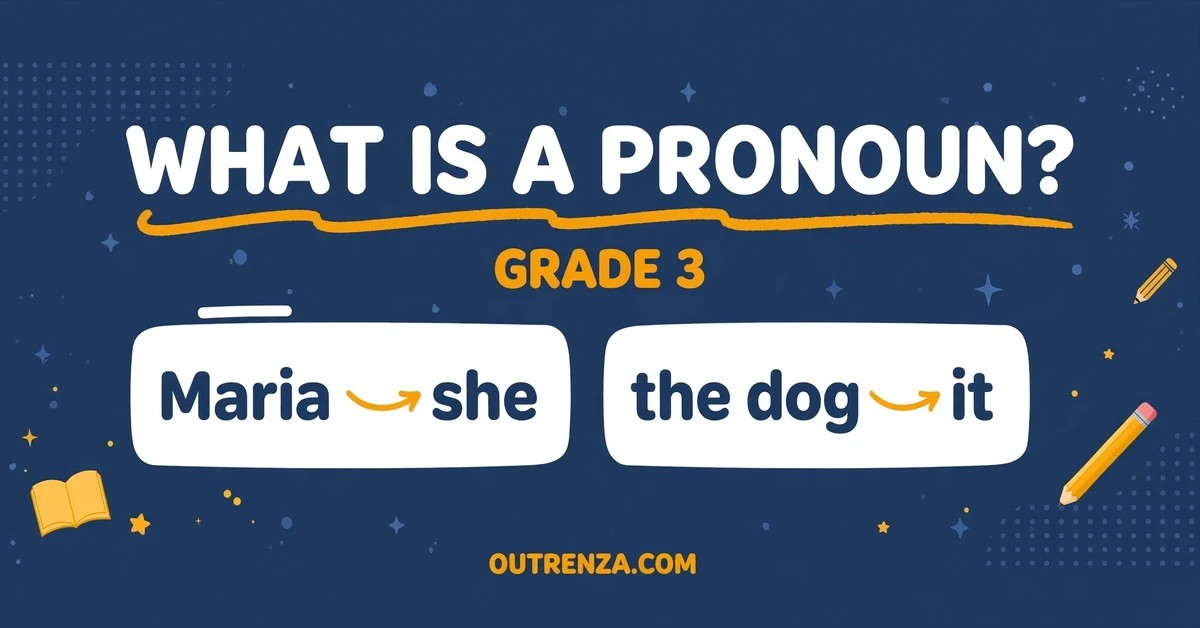
Grade 3 • Pronouns • About 20 minutes
You will learn to: spot the little stand-in words • swap a noun for a stand-in • choose the right word for the job
Includes: the Stand-In Rule • stand-in word cards • 3 practice rounds • a bonus swap challenge • a full answer key
Curriculum: Builds on CCSS L.1.1.d (personal, possessive, and indefinite pronouns); supports L.3.1a (the function of pronouns in particular sentences).
Quick answer: A pronoun is a small word that takes the place of a noun. Instead of saying a name again and again, English swaps in a stand-in: he, she, it, we, they, me, him, this, mine. Name the noun once, and the little stand-ins carry it through the rest of the sentence.
The Stand-In Rule
A pronoun is a stand-in word. First the sentence names the noun — Maya, the dog, the ball. After that, a little word can step in and do the noun’s job: she, it, they. The stand-in only works because the name came first. No name, no stand-in.
Think of the silliest sentence in the world: “Tom chased Tom’s ball, and Tom kicked the ball into Tom’s yard.” Every name repeats, and the sentence trips over itself. Now hear it fixed: “Tom chased his ball, and he kicked it into his yard.” Same story — half the tripping. So what is a pronoun, and how do you spot one every time? This page answers that question with one rule, one swap at a time, and plenty of practice. (New to naming words? What Is a Noun? teaches the naming rule first, and Identifying Nouns turns finding them into a detective game.)
What Is a Pronoun? A Simple Definition
A noun names a person, place, thing, or idea — Maya, park, ball, courage. Pronouns are the small words that stand in for those names once we know them. English keeps a whole team of them because names are heavy: say a name once, then let the little words run with it.
Every stand-in points back to a name. Read “She dropped it,” and your brain hunts for who she is and what it is. If the names came earlier — “Ana dropped her glass” — the hunt is over before it starts. Writers name first, then point. That is the whole system.
Watch It Happen: One Swap, Step by Step
Start with the clunky version: “Nora fed Nora’s cat because Nora’s cat was hungry.”
- Nora — the name. Say it once, proudly. ✔ it stays
- Nora’s (the second one) — the name again, doing owner duty. Swap in the owner word: her
- Nora’s (the third one) — still repeating. Swap again: her
The fixed sentence: “Nora fed her cat because her cat was hungry.” Two swaps, zero tripping. Notice what did not change: cat stayed cat. Only the name got stand-ins — names are the heavy part of a sentence, and heavy parts are what stand-ins are for.
Meet the Team: The Words That Stand In
These are the stand-ins Grade 3 writers use every day, grouped by the job they do.
THE DOERS
I, you, he, she, it, we, they
THE RECEIVERS
me, you, him, her, it, us, them
THE OWNERS
my, mine, your, yours, his, her, hers, our, ours, their, theirs
THE POINTERS
this, that, these, those
Two things to notice. First, you and it work on both teams — doers and receivers. Second, the owners come in pairs: my stands in front of a noun (my book), while mine stands all alone (the book is mine). One busy word — his — does both jobs. A later post in this series gives the owner words a page of their own.
Pronoun or Noun? How to Tell Them Apart
Both kinds of words can start a sentence, so how do you tell them apart? Ask one question: does the word name, or does it point? Teacher names — you can picture one. She only points — you must already know who. If a word needs a name from earlier to make sense, it is a stand-in, not a name.
- Names: Maya, teacher, park, ball, kindness — they name all by themselves.
- Points: she, it, they, mine, this — they need a name that came first.
- The swap test: trade the word for a name. If the sentence still works and just sounds clunkier — “She ran” → “Maya ran” — you found a stand-in.
Practice Rounds: Spot It, Swap It
Each round gets a little trickier. Finish a whole round before peeking at the key.
Round 1 — Circle the Stand-Ins. Each sentence hides stand-in words. Find them all — 21 are hiding in these 8 sentences. 1. She gave the book to him. 2. We watered the plants, and they grew tall. 3. The puppy wagged its tail when it saw us. 4. I forgot my umbrella, so Ben lent me his. 5. You can sit with us. 6. The baby birds opened their beaks, and we fed them. 7. This is my favorite song. 8. Grandma told us a story, and we loved it.
Round 2 — Swap the Name. Each sentence says a name one time too many. Rewrite it with a stand-in so it reads smoothly. 1. Ravi kicked the ball, and the ball rolled under the bench. 2. Mom smiled because Mom was proud. 3. The kittens shared the kittens’ warm blanket. 4. Sara and I built a fort, and then Sara and I hid inside it.
Round 3 — Stand-In or Not? Say “stand-in” or “not” for each word. Some of these are traps from the noun lessons. 1. she 2. quickly 3. them 4. table 5. we 6. jump 7. mine 8. under 9. it 10. bravery
Bonus Round — The Great Swap. This little story names Lily again and again. Rewrite it with stand-ins so it reads smoothly. “Lily found a shell on the beach. Lily showed the shell to Tom. Tom said the shell was the prettiest shell on the beach. Lily smiled and put the shell in Lily’s bucket.”
Answer Key
Check Answers — Full Answer Key (for grown-ups)
Round 1 — Circle the Stand-Ins (all 21)
1. she, him. 2. we, they. 3. its, it, us. 4. I, my, me, his. 5. you, us. 6. their, we, them. 7. this, my. 8. us, we, it.
Round 2 — Swap the Name
1. Ravi kicked the ball, and it rolled under the bench.
2. Mom smiled because she was proud.
3. The kittens shared their warm blanket.
4. Sara and I built a fort, and then we hid inside it.
Round 3 — Stand-In or Not?
1. she — stand-in.
2. quickly — not (it describes an action).
3. them — stand-in.
4. table — not (a noun — it names).
5. we — stand-in.
6. jump — not (an action).
7. mine — stand-in.
8. under — not (a position word).
9. it — stand-in.
10. bravery — not (a noun — an idea).
Bonus Round — The Great Swap (one good rewrite)
“Lily found a shell on the beach. She showed it to Tom. He said it was the prettiest shell on the beach. Lily smiled and put it in her bucket.”
Key note: many good rewrites exist. The test is the pointing — every stand-in must point back to a name the reader already knows.
For Teachers: Running the Practice in Class
Before you start (2 minutes)
- Write the Stand-In Rule on the board: name it first, then point.
- Read the clunky Nora sentence aloud, then the fixed one. Let the class hear the difference before you explain it.
You need: the rounds above on screen or printed; a pencil per child.
Timing (about 20 minutes): rule + definition 5 • worked swap 3 • Rounds 1–2 6 • Round 3 + Bonus 3 • check together 3.
Support: partners read each sentence twice — once hunting names, once hunting stand-ins; keep the word cards visible.
Challenge: the Bonus rewrite — most classes keep one name too many; ask “which name is still doing a stand-in’s job?”
Grown-up word: the name a stand-in points back to is called its antecedent. Handy for lesson plans and report cards; students do not need it.
Quick check: call a name — the twins, Ms. Roy, the cake — students answer with a stand-in: they, she, it.
Wrong vs Right: 4 Traps That Catch Stand-In Users
Trap 1 — A stand-in with no name first
❌ Wrong: Starting a story with “She took it to the place and put it there.”
✅ Right: “Maya took the book to the library and put it on the shelf.” Name the person, the thing, and the place once — after that, the little words are perfectly clear.
Trap 2 — “Me and him” at the start
❌ Wrong: “Me and him went to the park.”
✅ Right: “He and I went to the park.” Test it by dropping the other person: “Me went” sounds wrong; “I went” sounds right. Starter sentences take the doer words — I, he, she, we, they.
Trap 3 — The name that never stops
❌ Wrong: “Tom fed Tom’s cat because Tom’s cat was hungry, so Tom gave Tom’s cat more food.”
✅ Right: “Tom fed his cat because it was hungry, so he gave it more food.” Once a name is said, stand-ins keep the sentence smooth — that is their whole job.
Trap 4 — It’s or its?
❌ Wrong: “The dog wagged it’s tail.”
✅ Right: “The dog wagged its tail.” It’s always means it is. The owner word its never wears an apostrophe. (Owner nouns are the opposite — they do take one: Possessive Nouns.)
One-Minute Final Check
Try these without looking back.
1. Which word is a stand-in: fast, she, jump?
2. Swap the name: “Ben lost Ben’s hat.” Say it the smooth way.
3. True or false: these little words name a person, place, or thing.
4. Fix the start: “Me and her played outside.”
5. Which little word fits: “The seeds sprouted because ___ rained all week”?
Check your answers
1. she — the only pointing word.
2. “Ben lost his hat.”
3. False — they stand in for names; nouns do the naming.
4. “She and I played outside.”
5. it — weather takes it.
Check Yourself: I Can…
Checked your answers? Tick each box that is true for you:
- ☐ I can explain the job of a stand-in word: it takes the place of a noun.
- ☐ I can find the stand-ins in a sentence — even sneaky ones like its.
- ☐ I can swap a repeated name for the right little word.
- ☐ I can spot the traps: no name first, “me and him,” and it’s in the wrong place.
How did it feel? 😀 I did it! 🙂 Almost — one more try. 🌱 I need more practice.
The stand-in I use most: ___
Remember: name it first, then point. A noun does the naming — Maya, dog, ball. After the name is said, the little stand-ins carry it through the sentence: she, it, they, mine. Name once, point after, and no sentence ever trips over its own names.
Frequently Asked Questions
What is a pronoun?
Pronouns are the small words that take the place of nouns: he, she, it, we, they, me, this, mine. Instead of repeating a name — “Ana watered Ana’s plants” — English swaps in stand-ins: “Ana watered her plants.” Name the noun once, and the little words carry it from there.
Is “I” a naming word?
No. I names nobody — it stands in for the speaker’s own name, whatever that name is. The same family works for everyone you talk about: you for the listener, he and she for others, we for a group with you in it, and they for a group without you.
How are nouns and pronouns different?
A noun names: teacher, park, ball, kindness. The little words only point: she could be any girl or woman until a name tells you which one. Test any word by asking — does it name all by itself, or does it need a name from earlier? Names pass the first test; stand-ins pass the second.
Can these little words start a sentence?
Yes. She can open a sentence as long as the name came before — in the sentence just before, or earlier in the story: “Maya packed her bag. She zipped it shut.” If no name has been said yet, start with the name instead.
What about “my” and “mine”?
Both are owner words. My always stands in front of a noun — my book — while mine stands all alone: “The book is mine.” His is the busy one: it does both jobs. The owner words get a full post of their own later in this series.
How many stand-in words are there?
Fewer than you might think. A core team of about thirty does nearly all the work in everyday English — the doers, receivers, owners, and pointers on this page. The next post in this series sorts the whole family into its kinds, one kind at a time.
Lesson Path: Keep Learning
Step 1 — Learn it: What Is a Noun? — the pillar guide to naming words
Step 2 — Find it: Identifying Nouns — spot every noun in a sentence
Step 3 — Swap it: What Is a Pronoun? (you are here)
Step 4 — Sort them: Types of Pronouns — the whole family of stand-ins, sorted kind by kind
Keep Learning: Your Next Steps
- 📘 What Is a Noun? — the pillar guide: definition, the three noun tests, 100+ examples.
- 📗 Types of Nouns: Definition, Examples, and Worksheets for Kids — the hub: all 10 noun types, with a printable chart.
- 🔍 Identifying Nouns: How to Find Every Noun in a Sentence — the detective practice this post builds on.
- 🔗 Coming next: Types of Pronouns — personal, possessive, reflexive, and five more kinds, each with examples.
- 🔗 Also in this series: Personal Pronouns: Subject and Object — I vs. me, he vs. him, settled for good.
- 🔗 Also in this series: Possessive Pronouns vs Possessive Adjectives — mine vs. my, the mix-up every writer meets.

Founder & Editor, Outrenza. Irshad Ullah Asad is a linguist and experienced content writer with an M.Phil in Linguistics. For the past 15 years, he has taught postgraduate classes, helping advanced students master the structure and use of the English language. At Outrenza, he turns that deep expertise into simple, practical grammar lessons — clear explanations, rich examples, and free printable worksheets — so teachers, parents, and students can learn parts of speech and core grammar with confidence. His academic background in linguistics ensures that every lesson on Outrenza is accurate, well-structured, and easy to follow.