
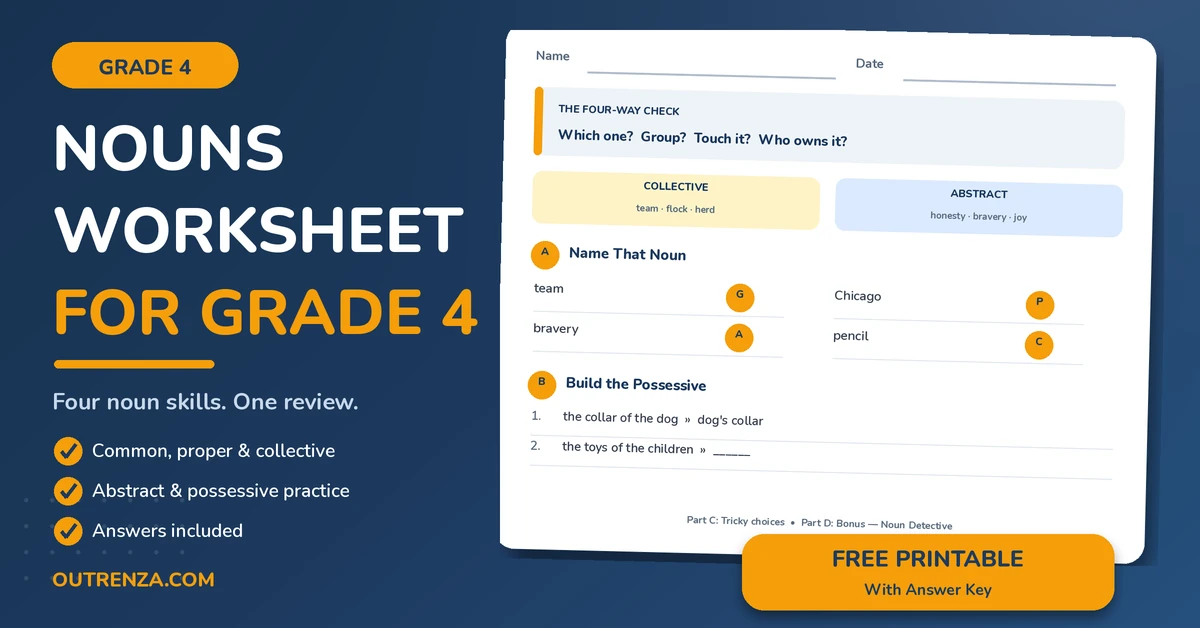
Grade 4 • Noun Review • About 25 minutes
You will learn to: tell common from proper • name collective nouns • spot abstract nouns • write possessive nouns
Includes: 4 activities • a free printable PDF • a teacher guide • a full answer key
Curriculum: Reviews CCSS L.1.1.b (common and proper nouns) and L.3.2d (form and use possessives); supports Grade 4 grammar and usage under CCSS L.4.1 and correct capitalization under CCSS L.4.2a.
The Four-Way Check
Ask four quick questions about any noun:
Which one? → common or proper. One word for a whole group? → collective. Can I touch it? → if not, abstract. Who owns it? → possessive, with an apostrophe.
This free nouns worksheet for grade 4 practices all four checks in one mixed review: label it, build it, choose it, hunt it. Full answer key included — about 25 minutes.
What This Nouns Worksheet for Grade 4 Reviews
By Grade 4, kids have met nouns one kind at a time. This review mixes them together — the way real writing does. One sentence may hold a proper noun, the next a group word, and the one after that a feeling you cannot touch. The job is to slow down, run the Four-Way Check, and name each kind with confidence.
| Noun kind | The quick question | Clue | Examples |
|---|---|---|---|
| Common | Which one? Any one. | General name, no capital | teacher, city, pencil |
| Proper | Which one? That one, by name. | Specific name, always a capital | Ms. Carter, Chicago |
| Collective | One word for a whole group? | Names the group as one unit | team, flock, class |
| Abstract | Can I touch it? | Idea or feeling — no touching | honesty, bravery, freedom |
| Possessive | Who owns it? | Shows ownership, takes an apostrophe | dog’s, boys’, children’s |
Possessive is a job a noun does, not a fifth family — any common or proper noun can turn possessive when it owns something: the dog’s collar, Emma’s idea. New to the basics? Start with What Is a Noun?; the full map of noun types is Types of Nouns.
COMMON → PROPER
city → Chicago
COLLECTIVE
team, flock, herd
ABSTRACT
honesty, bravery, joy
POSSESSIVE
dog’s, boys’, children’s
How to Use This Nouns Worksheet for Grade 4
- Print it, or work on screen. Each part works alone — Parts A and B today, the rest tomorrow.
- Say the Four-Way Check out loud. It settles almost every question on this page.
- Part D is a bonus hunt. Harder on purpose — save it for fast finishers or try it together.
- Check with the answer key. Finish a whole part first, then check together.
For Teachers: Using This Worksheet in Class
Before you start (3–4 minutes)
- Write the Four-Way Check on the board: Which one? Group? Touch it? Who owns it?
- Run it once together on flock — a group word, so collective — then point to Part B, Question 1: already worked.
You need: one printed sheet per child (PDF pages 1–2) and a pencil.
Timing (about 25 minutes): teach 5 • Parts A–C 14 • check together 6. Part D runs on its own for fast finishers.
Support (for students who need a step up): keep the refresher table visible, do Part A in pairs, and let students say the four questions to a partner first.
Challenge (for fast finishers): Part D — one paragraph hiding all four kinds plus a possessive.
Quick check before they leave: each student names one noun and its kind: “flock — collective.” Ten seconds each shows who owns the check.
Homework: send pages 1–2 home; keep the key (page 3) and this guide (page 4) at school.
Part A — Name That Noun
Look at the bold noun in each sentence. Label it: C = common, P = proper, G = collective (group), A = abstract. The list hides exactly three of each kind.
- The team celebrated after the game.
- Honesty is always the best choice.
- Ms. Carter teaches our class this year.
- The dog chased the ball across the yard.
- A flock of geese flew over the lake.
- His bravery surprised everyone on the field.
- We visited Chicago in the spring.
- The children shared their crayons.
- Freedom is a treasure worth protecting.
- Our class won the reading contest.
- Please hand me that pencil.
- The parade marched down Main Street.
Hint: a collective noun still names the group as ONE unit — one team, one flock, one class.
Part B — Build the Possessive
Rewrite each phrase as a possessive noun. The first one is done for you. Watch the owners: some are one, some are many, and two plurals do not end in s.
- (done for you) the collar of the dog → the dog’s collar
- the bikes of the boys → ___
- the idea of Emma → ___
- the toys of the children → ___
- the nest of the birds → ___
- the hat of Mr. Ross → ___
- the seeds of the farmers → ___
- the voices of the women → ___
Hint: one owner → add ’s. Many owners ending in s → add only ’. Many owners NOT ending in s (children, women) → add ’s.
Part C — Tricky Cases: You Choose
Circle the right choice in each sentence. Every question tests a different corner of the Four-Way Check.
- A (flock / herd) of cows crossed the field.
- We watched a (swarm / bunch) of bees by the hive.
- The (childrens / children’s) art hung in the hall.
- One fox slept in the (fox’s / foxes’) den.
- His (courage / backpack) helped him speak up in class.
- The (teams / team’s) uniforms were washed after the game. (one team)
- We drove to (Atlanta / atlanta) to see the aquarium.
- A (pack / pride) of wolves howled at the moon.
Talk it over: Questions 1, 2, and 8 are all collective nouns — but each animal group has its own word. Cows travel in a herd, bees in a swarm, wolves in a pack.
Bonus Challenge — Part D: Noun Detective
One short paragraph, every kind hiding inside. Read it twice, then hunt.
“On Saturday, the choir from Lincoln School sang at the spring fair. Their sweet music filled the park with joy. Mrs. Lee, the director, smiled at the happy crowd. “Your hard practice paid off,” she said. Then Maya lifted her brother’s trophy high, and the singers cheered.”
Find and write:
- One proper noun: ___
- One collective noun: ___
- One abstract noun: ___
- One possessive noun: ___
- Two common nouns: ___ and ___
The secret: a possessive noun is the easiest one to spot — it is the only noun wearing an apostrophe.
Notes for Teachers and Grown-Ups
This nouns worksheet for grade 4 is a review, not a first lesson — it works best after students have met each noun kind on their own.
- One part at a time is fine. Parts A and B make one session; Parts C and D make another.
- Part B, Question 1 is worked. Study it first — it shows the pattern every other answer follows.
- The apostrophe questions carry the grade. Singular owners, plural owners ending in s, and the two rebels (children, women) are exactly where Grade 4 writers slip.
- Part C collects the confusions. Pride belongs to lions, not wolves; children’s keeps its ’s because children does not end in s.
- Part D is optional and ungraded. It previews the mixed reading Grade 5 expects; finding four of the five targets is a win.
- Kind first, spelling second. A correct label with shaky spelling still shows the skill.
Wrong vs Right: 4 Mistakes Grade 4 Kids Often Make
Mistake 1 — An apostrophe in a plain plural
❌ Wrong: “I saw three dog’s at the park.”
✅ Right: “I saw three dogs at the park.”
More than one is just -s. The apostrophe appears only when the noun owns something.
Mistake 2 — ’s after a plural that ends in s
❌ Wrong: “the girls’s room”
✅ Right: “the girls’ room.”
When the owners word already ends in s, add only the apostrophe.
Mistake 3 — Capitalizing feelings and ideas
❌ Wrong: “Her Honesty made her a good friend.”
✅ Right: “Her honesty made her a good friend.”
Abstract nouns are common nouns — small letters, unless they start the sentence.
Mistake 4 — Treating a group word as many
❌ Wrong: “The team are ready.”
✅ Right: “The team is ready.”
In US writing, a collective noun works as one unit, so it takes the singular verb.
Answer Key
Check Answers — Answer Key (for grown-ups)
The full key for this nouns worksheet for grade 4 sits below — check one whole part at a time.
Part A — Name That Noun
- team — G, collective (one word for the whole group)
- Honesty — A, abstract (a quality; you cannot touch it)
- Ms. Carter — P, proper (one teacher, by name)
- dog — C, common (any dog)
- flock — G, collective (one word for the group of geese)
- bravery — A, abstract (a quality)
- Chicago — P, proper (one city, by name)
- children — C, common (kids in general, no names)
- Freedom — A, abstract (an idea)
- class — G, collective (the group as one unit)
- pencil — C, common (any pencil)
- Main Street — P, proper (one street, by name)
Part B — Build the Possessive
- the dog’s collar (worked example — one owner, add ’s)
- the boys’ bikes (many owners, boys ends in s — apostrophe only)
- Emma’s idea (one owner, a name — add ’s)
- the children’s toys (children does not end in s — add ’s)
- the birds’ nest (many owners, birds ends in s — apostrophe only)
- Mr. Ross’s hat (one owner — add ’s even though the name ends in s; Ross’ is also seen in print)
- the farmers’ seeds (many owners, farmers ends in s — apostrophe only)
- the women’s voices (women does not end in s — add ’s)
Part C — Tricky Cases
- herd — cows travel in a herd; a flock is birds (or sheep and goats).
- swarm — bees gather in a swarm.
- children’s — children does not end in s, so the possessive takes ’s.
- fox’s — one fox owns the den; foxes’ would mean many foxes.
- courage — the abstract noun; a backpack cannot help anyone speak.
- team’s — one team owns the uniforms, so singular possessive ’s.
- Atlanta — a city name is proper, capital everywhere.
- pack — wolves run in a pack; a pride is lions.
Bonus Challenge — Part D: Noun Detective
- Proper noun: Saturday, Lincoln School, Mrs. Lee, or Maya (any one — all four are hiding there)
- Collective noun: choir (crowd also counts — both name a whole group as one)
- Abstract noun: joy (the one clear feeling word; music, practice, and the fair can be heard, done, or visited)
- Possessive noun: brother’s (the only apostrophe in the paragraph)
- Common nouns (any two): fair, music, park, director, trophy, singers
Key note: the possessive is the giveaway — it is the only noun in the paragraph wearing an apostrophe.
Check Yourself: I Can…
Checked your answers? Tick each box that is true for you:
☐ I can label nouns — common, proper, collective, and abstract.
☐ I can build possessives with ’s and ’ in the right places.
☐ I can choose the right group word — herd, swarm, pack.
☐ I played Noun Detective and found the kinds hiding in a paragraph.
How did it feel? 😀 I did it! 🙂 Almost — one more try. 🌱 I need more practice.
The noun kind I know best now: ___
Remember: Run the Four-Way Check
Which one? common or proper • Group? collective • Touch it? abstract • Who owns it? possessive
- Common / Proper: teacher / Ms. Carter — city / Chicago
- Collective: team, flock, class
- Abstract: honesty, bravery, freedom
- Possessive: dog’s, boys’, children’s
Stuck? Ask the four questions in order. The first one that answers is the kind.
Lesson Path: Keep Learning
Step 1 — Learn it: Common Noun and Proper Noun — the capital-letter rule behind the first check
Step 2 — Warm up: Common and Proper Nouns Worksheet for Grade 3 — sort, fix, and choose at Grade 3 level
Step 3 — Practice it: Nouns Worksheet for Grade 4 with Answers (you are here)
Step 4 — Grow it: Types of Nouns — all 10 noun types, with a printable chart
Frequently Asked Questions
What noun skills does this nouns worksheet for grade 4 practice?
Four kinds of nouns in one mixed review: common and proper nouns (with their capital letters), collective nouns like team and flock, abstract nouns like honesty and freedom, and possessive nouns with apostrophes — dog’s, boys’, children’s.
What is a collective noun?
A collective noun is one word that names a whole group as a single unit: a team of players, a flock of geese, a herd of cows, a swarm of bees, a pack of wolves. In US writing it usually takes a singular verb: the team is ready.
How can kids spot an abstract noun?
Use the touch test. If you cannot see it, touch it, hear it, or take a photo of it, it is probably abstract: honesty, bravery, freedom, joy, courage. People, places, and things you can point to are concrete.
When does a possessive noun take ’s, and when only an apostrophe?
One owner: add ’s (the dog’s collar, Emma’s idea). Many owners whose word already ends in s: add only the apostrophe (the boys’ bikes, the farmers’ seeds). Many owners whose word does not end in s: add ’s (the children’s toys, the women’s voices).
How long should this worksheet take?
This nouns worksheet for grade 4 takes about 25 minutes in one sitting. Parts A and B are the core; Part C is for discussion, and Part D is an optional bonus hunt. Each part also works on its own across two shorter sessions.
Is this worksheet really free? Can I use it in my classroom?
Yes. The PDF is free, key and teacher guide included — no email required. Teachers may print it freely; for homework, send pages 1–2 home and keep the key at school.
Download the Free Printable
PDF built with this draft: nouns-worksheet-grade-4.pdf — p.1 Parts A–C; p.2 Part D + self-check; p.3 answer key; p.4 teacher guide. This nouns worksheet for grade 4 prints on four pages, key and guide included.
Keep Learning: Your Next Steps
- 📘 Common Noun and Proper Noun: Difference, Examples, and Worksheet — the guide behind the first check, with the tricky capital cases.
- 📗 Types of Nouns: Definition, Examples, and Worksheets for Kids — the hub: all 10 noun types, with a printable chart.
- 📘 What Is a Noun? — the pillar guide: definition, three noun tests, 100+ examples.
- 📝 Common and Proper Nouns Worksheet for Grade 3 — Free Printable with Answers — the Grade 3 step before this review: sort, fix the capitals, crack tricky cases.
- 📝 Nouns Worksheet for Grade 1 — Free Printable with Answers — a gentler starter: circle, sort, and fill in nouns.
- 🐝 Collective Nouns for Grade 4 — the next post in this series goes deep on group words: herd, swarm, pride, pack, and 100 more.

Founder & Editor, Outrenza. Irshad Ullah Asad is a linguist and experienced content writer with an M.Phil in Linguistics. For the past 15 years, he has taught postgraduate classes, helping advanced students master the structure and use of the English language. At Outrenza, he turns that deep expertise into simple, practical grammar lessons — clear explanations, rich examples, and free printable worksheets — so teachers, parents, and students can learn parts of speech and core grammar with confidence. His academic background in linguistics ensures that every lesson on Outrenza is accurate, well-structured, and easy to follow.