
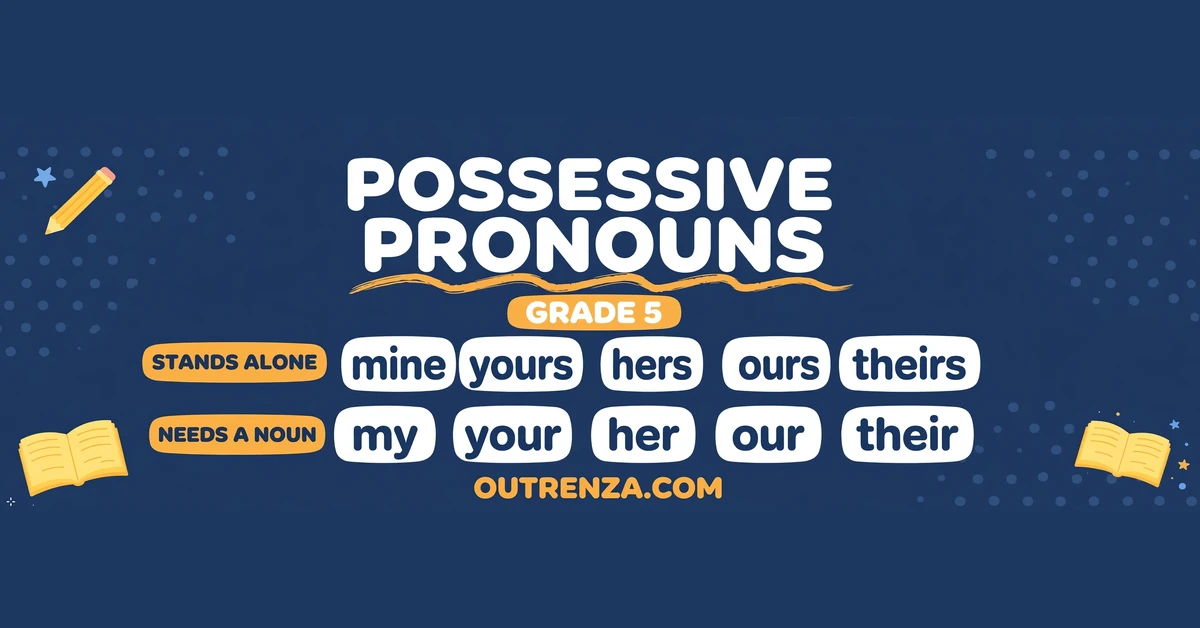
Grade 5 • Possessive Pronouns • About 20 minutes
You will learn to: tell the two owner sets apart • use the job test • beat the its/it’s trap
Includes: a side-by-side chart • 3 practice rounds • a bonus rewrite • a full answer key
Curriculum: Builds on CCSS L.1.1.d (personal and possessive pronouns); supports L.3.1a (the function of pronouns in particular sentences).
Quick answer: Possessive pronouns are owner words that stand alone and replace a whole phrase: The book is mine — not “my book,” just mine, doing the whole job. Their partners, the possessive adjectives — my, your, his, her, its, our, their — do the opposite job: they stand before a noun. Neither set ever takes an apostrophe.
Two Jobs, One Family
Every owner word works one of two jobs. Before a noun, it is a possessive adjective: my book, her coat, their bus. Standing alone, it does the whole job by itself: The book is mine. The coat is hers. The bus is theirs. Ask one question — “Is a noun standing right after it?” — and you will always pick the right word.
In the last cluster you met owners with apostrophes — Possessive Nouns like the girl’s bag. Today’s owners play by a stranger rule: they show ownership with no apostrophe at all, and they split into two teams that students mix up every day. This page sorts possessive pronouns from their before-a-noun partners once and for all — with the its/it’s trap disarmed along the way. (New to spotting nouns? Identifying Nouns is the warm-up.)
Before the Noun: The Adjective Job
The first team never travels alone. A possessive adjective leans on a noun and answers “Whose?” right in front of it: my pencil, your turn, his bike, her idea, its cover, our class, their team. Cross out the noun and the sentence falls over — “Is that my?” goes nowhere at all. These words behave like adjectives: they point at one specific thing by naming its owner.
BEFORE A NOUN (possessive adjectives)
my, your, his, her, its, our, their
Possessive Pronouns Stand Alone
The second team needs no noun at all. Each word carries the owner and the thing owned in a single package: mine means “my + the thing we are talking about.” The keys are mine. That seat is yours. The last slice is his. The choice is hers. The win is ours. The decision is theirs. Notice the shapes as they cross over: my becomes mine, her becomes hers, our becomes ours, their becomes theirs — and his simply works both jobs without changing at all.
STANDING ALONE
mine, yours, his, hers, ours, theirs
One seat at the table stays empty: its has no standing-alone partner. You can say “The tree dropped its leaves,” but never “The leaves are its.” When you reach that gap, rebuild the sentence — the leaves belong to the tree — or simply repeat the noun.
The Whole Family, Side by Side
| Owner | Before a noun (adjective job) | Standing alone (pronoun job) | Watch it work |
|---|---|---|---|
| I | my | mine | my desk → the desk is mine |
| you | your | yours | your turn → the turn is yours |
| he | his | his | his bike → the bike is his |
| she | her | hers | her coat → the coat is hers |
| it | its | — (no form) | its cover → (rebuild the sentence) |
| we | our | ours | our class → the class is ours |
| they | their | theirs | their team → the team is theirs |
The job test settles every close call. Is a noun coming right after the owner word? Use the adjective form. Is the word finishing the thought by itself? Use the standing-alone form. Try the frame “The book is ___” — only the alone-forms fit it: mine, yours, his, hers, ours, theirs. Then try “___ book” — only the adjective forms fit. Two frames, zero guessing.
The Trap With Teeth: its vs it’s
Here is the mix-up that bites even strong writers. Its (no apostrophe) is an owner word from the chart above: The dog wagged its tail. The book lost its cover. It’s (with an apostrophe) is not an owner at all — it is a contraction, a squeezed form of it is or it has: It’s raining. It’s been a long day.
Why do owner words refuse apostrophes when nouns demand them? Because the apostrophe in the girl’s bag marks a noun turning into an owner. Owner words like its, yours, and hers are owners by birth — they need no mark. Test any doubtful sentence by expanding it: if it is fits, write it’s; if it does not, write its. And the rule covers the whole family — no apostrophe in yours, hers, ours, theirs, or mine, ever. Nouns take the apostrophe; pronoun owners never do. The full noun rules live in Possessive Nouns.
Practice Rounds: Choosing Possessive Pronouns
Three rounds, one per skill. Finish a whole round before peeking at the key.
Round 1 — Which Job? Read each sentence. The bold owner word is doing one of the two jobs — write A (before a noun) or P (standing alone). 1. Her backpack is blue. 2. The blue backpack is hers. 3. Our team won the game. 4. The victory was ours. 5. Is this your pencil? 6. No — mine is yellow. 7. Their bus is late again. 8. The choice is theirs.
Round 2 — Choose the Right Word. Circle the form that fits the job. 1. This seat is ( my / mine ). 2. ( Her / Hers ) brother is tall. 3. The decision is ( their / theirs ). 4. Is that ( your / yours ) lunchbox? 5. The trophy is ( our / ours )! 6. ( His / His ) bike is red — and the red one is ( his / his ).
Round 3 — Fix the Owner Mistakes. Each sentence breaks one rule from this page. Rewrite each one correctly. 1. The book is mines. 2. The dog wagged it’s tail. 3. Is this pen yours’s? 4. That seat is her. 5. Theirs car is new.
Bonus — Say It Standing Alone. Rewrite each sentence so the owner word stands alone. 1. This is my jacket. 2. Those are her gloves. 3. That is their classroom. 4. These are our seats.
Answer Key
Check Answers — Full Answer Key (for grown-ups)
Round 1 — Which Job?
1. A — her stands before backpack. 2. P — hers stands alone. 3. A — before team. 4. P — alone. 5. A — before pencil. 6. P — mine stands alone. 7. A — before bus. 8. P — alone.
Round 2 — Choose the Right Word
1. mine — standing alone. 2. Her — before brother. 3. theirs — alone. 4. your — before lunchbox. 5. ours — alone. 6. His — before bike; his — standing alone. (His is the same word in both jobs.)
Round 3 — Fix the Owner Mistakes
1. The book is mine. (Mine never takes an s.) 2. The dog wagged its tail. (Its = owner; it’s = it is.) 3. Is this pen yours? (Yours takes no apostrophe and no extra s.) 4. That seat is hers. (Her must lean on a noun.) 5. Their car is new. (Before a noun, use the adjective form.)
Bonus — Say It Standing Alone
1. This jacket is mine. 2. Those gloves are hers. 3. That classroom is theirs. 4. These seats are ours.
For Teachers: Running the Practice in Class
Before you start (2 minutes)
- Write the job test on the board: Is a noun standing right after it? Yes → adjective form. No → standing-alone form.
- Hold up your own pen: “This is my pen” (point at the pen). Put it down, hands empty: “The pen is mine.”
You need: the rounds above on screen or printed; a pencil per child.
Timing (about 20 minutes): two jobs 4 • family chart 2 • its/it’s trap 3 • Rounds 1–2 6 • Round 3 + Bonus 3 • check together 2.
Support: let students cover the word right after the owner word with a thumb — if a noun hides under the thumb, the adjective form wins.
Challenge: the empty chair — ask strong writers why its has no standing-alone form, and to rescue “The leaves are its” in two different ways.
Quick check: call two frames — “___ locker” and “The locker is ___” — students answer their / theirs and name the job each one is doing.
Wrong vs Right: 4 Owner Mistakes to Fix
Mistake 1 — Mines
❌ Wrong: “The book is mines.”
✅ Right: “The book is mine.” Mine is already complete — it never takes an s, however many books there are.
Mistake 2 — It’s the owner
❌ Wrong: “The bird built it’s nest.”
✅ Right: “The bird built its nest.” Expand it: “it is nest” makes no sense — so no apostrophe. It’s only ever means it is or it has.
Mistake 3 — Yours’s
❌ Wrong: “Is this seat yours’s?”
✅ Right: “Is this seat yours?” Owner words are owners by birth — no apostrophe, and no extra s either.
Mistake 4 — Her standing alone
❌ Wrong: “The front seat is her.”
✅ Right: “The front seat is hers.” Her must lean on a noun (her seat). Alone at the end, the word is hers.
One-Minute Final Check
Try these without looking back.
1. Choose: “The last cookie is (my / mine).”
2. Fix it: “The bird built it’s nest on our porch.”
3. True or false: mine and yours need apostrophes to show ownership.
4. Which one stands alone: her or hers?
5. Fill both blanks (the owners are they): “___ dog is friendly, and the friendly dog is ___.”
Check your answers
1. mine — it stands alone.
2. its — owner word, no apostrophe.
3. False — never; apostrophes belong to nouns and contractions.
4. hers.
5. Their dog … the friendly dog is theirs.
Check Yourself: I Can…
Checked your answers? Tick each box that is true for you:
- ☐ I can tell the two jobs apart — before a noun, or standing alone.
- ☐ I can use mine, yours, hers, ours, and theirs with nothing after them.
- ☐ I can beat the trap: its owns, it’s means “it is.”
- ☐ I never put an apostrophe in an owner word.
How did it feel? 😀 I did it! 🙂 Almost — one more try. 🌱 I need more practice.
The owner word I will never mix up again: ___
Remember: ask what stands next to it. A noun right after? Adjective form — my book. Nothing after? That is where possessive pronouns work — the book is mine. And neither form ever wears an apostrophe: apostrophes belong to nouns, never to pronouns.
Frequently Asked Questions
What are possessive pronouns?
Possessive pronouns are owner words that stand alone and take the place of a whole phrase: mine, yours, his, hers, ours, theirs. “The umbrella is mine” says everything “the umbrella is my umbrella” would — in a single word, with no noun after it.
How can I tell the two owner sets apart?
Run the job test. If a noun stands right after the word, it is doing the adjective job: my book, her coat, their bus. If the word finishes the thought by itself, it is the standing-alone form: the book is mine, the coat is hers, the bus is theirs. Same owners — the shape changes with the job.
Why does “his” show up in both sets?
His is the one shape-shifter that refuses to change: his bike (before a noun) and the bike is his (standing alone). Every other owner word changes its shape when the job changes; his simply does double duty in the same uniform.
Is it “hers” or “her’s”?
Hers — always. No owner word in this family takes an apostrophe: hers, yours, ours, theirs, its. Apostrophes have two other jobs: they mark owners that started as nouns (the girl’s bag) and they squeeze contractions (it’s = it is).
What is the difference between its and it’s?
Its is the owner word: the dog wagged its tail; the book lost its cover. It’s is a contraction of it is or it has: it’s raining; it’s been fun. Expand the sentence in your head — if “it is” fits, choose it’s; if not, choose its.
Is there a standing-alone form of its?
No — its is the only owner word without one, so you cannot say “the leaves are its.” Rebuild the sentence instead: the leaves belong to the tree, or repeat the noun: the tree dropped its leaves, and the leaves covered the path.
Lesson Path: Keep Learning
Step 1 — Own it with a noun: Possessive Nouns — apostrophes belong to nouns: the girl’s bag
Step 2 — Pick the form: Personal Pronouns: Subject and Object Pronouns — I does it, me receives it
Step 3 — Own it alone: Possessive Pronouns vs Possessive Adjectives (you are here)
Step 4 — Practice it all: Pronouns Worksheet for Grade 4 — every pronoun job in one review
Keep Learning: Your Next Steps
- 🏷️ Possessive Nouns — the apostrophe owners: one owner, many owners, and the “of” test.
- 🔎 Identifying Nouns — find every noun first; owner words point back to them.
- 📗 Types of Nouns: Definition, Examples, and Worksheets for Kids — the hub: all 10 noun types, with a printable chart.
- 🔗 What Is a Pronoun? — where the whole pronoun family begins.
- 🔗 Types of Pronouns — every pronoun family on one page.
- 🔗 Personal Pronouns: Subject and Object Pronouns — I vs me, settled.

Founder & Editor, Outrenza. Irshad Ullah Asad is a linguist and experienced content writer with an M.Phil in Linguistics. For the past 15 years, he has taught postgraduate classes, helping advanced students master the structure and use of the English language. At Outrenza, he turns that deep expertise into simple, practical grammar lessons — clear explanations, rich examples, and free printable worksheets — so teachers, parents, and students can learn parts of speech and core grammar with confidence. His academic background in linguistics ensures that every lesson on Outrenza is accurate, well-structured, and easy to follow.