
Grade 4 • Phrases • About 20 minutes
You will learn to: say exactly what a phrase is • run the two checks • tell a phrase from a clause and a sentence • grow a plain sentence with phrases
Includes: phrase team cards • a phrase-or-clause table • 3 practice rounds • a bonus builder • a full answer key
Curriculum: Supports CCSS L.4.1.e (form and use prepositional phrases); builds on L.3.1.a (the function of words in particular sentences).
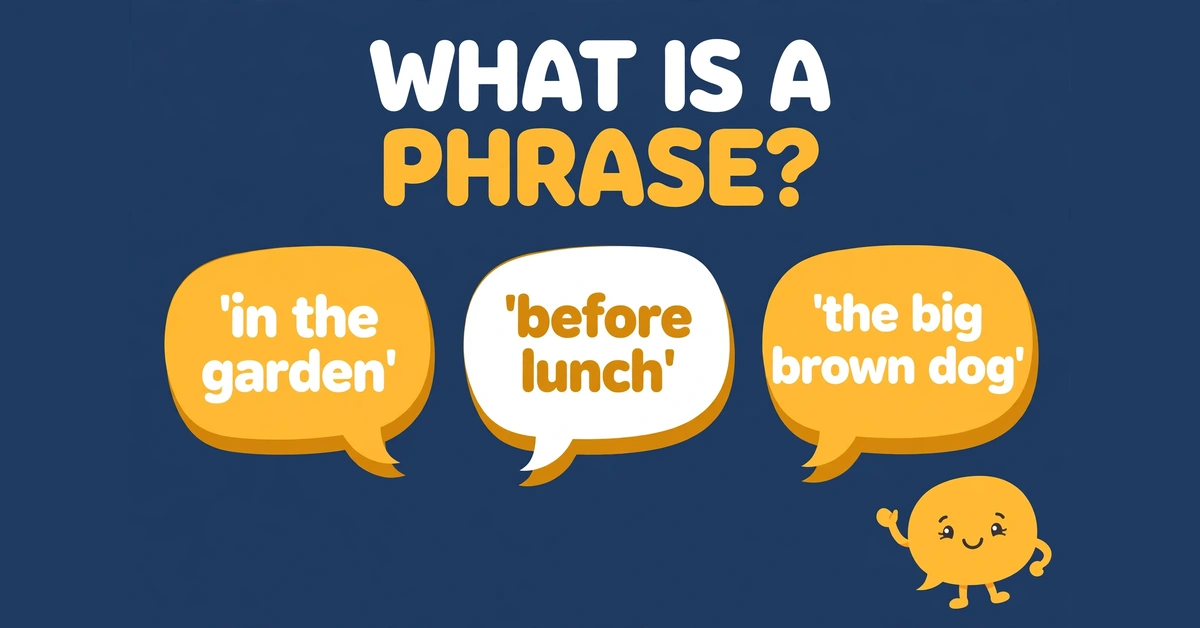
Quick answer: A phrase is a group of words that works as one part of speech inside a sentence — and it never contains a subject–verb pair. In the garden, before lunch, the big brown dog: each group does one job, and nobody inside the group is doing an action with a verb of their own. One team, no engine.
The Golden Rule: One Team, No Engine
A phrase is a team of words doing one job together, and the team carries no engine: there is no subject paired with its verb inside the phrase itself. Find a doer and that doer’s action word together — the dog barked — and you are not looking at a phrase any more. You are looking at a clause.
Words rarely travel alone. Read any sentence and your eyes grab chunks, not single words: after lunch, the tall tree, under my desk. Each chunk means one thing and does one job. If you have ever asked, “What is a phrase?” — it is the name grammarians give to one of those chunks. This page teaches you the two checks that prove a chunk is really a phrase, then lets you practise until the checks feel easy. (It helps to know the parts phrases are built from: What Is a Noun? covers the naming words, and Identifying Nouns shows how to spot them in the wild.)
What Is a Phrase? The Two Checks
So, what is a phrase, exactly? A group of words earns the name only when it passes both checks. One check is not enough.
Check 1 — No engine inside. A phrase never holds a subject–verb pair: a doer plus the action that doer does. In under the bed, the words point to a place, but nobody inside the group is doing anything. In the cat slept, the doer (cat) and its action (slept) sit side by side — engine found. Fail. That group is a clause, not a phrase.
Check 2 — One job, as a team. The words must work together as a single part of speech. The big brown dog names one thing, so the whole team works as a noun. Very quickly tells how, so the team works as an adverb. A string like of the and passes neither check: it has no engine, true, but it also does no job — it is just words standing near each other.
Run both checks on was running late: no subject hides inside it (who was running? the sentence must tell you) ✔ — and the words work as one action chunk ✔. It is a phrase — a verb phrase, one of the types the next post sorts out.
PHRASE TEAM CARDS
in the garden • under the bed • before lunch • after school • the tall green tree • with my best friend • on Friday morning • from the library • a cup of hot cocoa • at the top of the stairs
Meet the Teams: Three Jobs Phrases Do
Phrases do many jobs, but at this level you will meet three again and again. Think of them as three kinds of team — the next post in this series sorts all the types properly.
Works like a noun — names a person, place, or thing.
the big brown dog, a slice of pizza
Carries the action with its helper words.
has been waiting, is running fast
Tells more — which one, where, when, or how.
very tall, in the garden, after lunch
Notice the action team: has been waiting holds verb forms, yet it is still a phrase. Why? The subject — the one who waits — lives outside the phrase, in the rest of the sentence. A phrase can carry verb forms; it just never carries its own subject with them.
Phrase, Clause, or Sentence? The Line-Up
Three look-alikes cause most of the mix-ups. Line them up and test each one:
| Group | What is inside | Verdict |
|---|---|---|
| garden | one word only | a word — not a group, so not a phrase |
| in the garden | a group, one job (where), no subject–verb pair | phrase |
| the dog barked | a doer (dog) + its action (barked) | clause — engine inside |
| The dog barked in the garden. | one clause + one phrase, a complete thought | sentence |
Keep that answer in your pocket — a phrase is a group that works as one unit and holds no subject–verb pair — and the line-up will never fool you.
Practice Rounds: Finding Phrases
Three rounds, one per skill. Finish a whole round before peeking at the key.
Round 1 — Phrase or Not? Run the two checks, then write P (phrase) or N (not a phrase). 1. under the stairs 2. the bell rang 3. after the game 4. she smiled 5. a shiny new bike 6. with two hands 7. rain 8. was waiting quietly
Round 2 — Underline the Phrase. Each sentence hides one or two phrases. Underline each one you find. 1. The puppy hid under the porch. 2. We leave for the trip on Saturday. 3. Mia wrote a letter to her grandma. 4. The tall boy in the red cap waved at us. 5. Breakfast is on the table.
Round 3 — Finish It With a Phrase. End each sentence with a phrase of your own — it must pass both checks. 1. The cat slept ___. 2. We found the key ___. 3. Sam read his book ___. 4. The kite flew ___.
Bonus — Phrase Builder. Start with the bare sentence “The dog slept.” Grow it with two phrases — one that tells where, one that tells when — without changing the engine (dog slept).
Answer Key
Check Answers — Full Answer Key (for grown-ups)
Round 1 — Phrase or Not?
1. P — no engine, one job (where). 2. N — bell + rang: a subject–verb pair makes it a clause. 3. P. 4. N — she + smiled: a clause. 5. P — the whole group names one thing. 6. P. 7. N — one word is a word, not a group. 8. P — verb forms, but no subject inside the phrase.
Round 2 — Underline the Phrase
1. under the porch. 2. on Saturday (also for the trip). 3. to her grandma (also a letter works as the naming team). 4. in the red cap (also at us). 5. on the table.
Round 3 — Finish It With a Phrase
Answers vary; every answer must pass both checks. Samples: 1. The cat slept on the warm rug. 2. We found the key under the mat. 3. Sam read his book before dinner. 4. The kite flew over the park.
Bonus — Phrase Builder (one good build)
“The dog slept under the porch after lunch.” Accept any build that adds a where-phrase and a when-phrase and leaves dog slept untouched — the engine belongs to the sentence, never to a phrase.
For Teachers: Running the Practice in Class
Before you start (2 minutes)
- Write the two checks on the board: No engine inside and One job, as a team.
- Model one pass and one fail aloud: in the garden (pass) against the bell rang (engine found).
You need: the rounds above on screen or printed; a pencil per child.
Timing (about 20 minutes): two checks 5 • team cards + line-up 4 • Rounds 1–2 6 • Round 3 + Bonus 3 • check together 2.
Support: partners read each group twice — once hunting for a doer-and-action pair, once asking “what one job does it do?”
Challenge: the Bonus builder — strong writers add a third phrase (how: with its tail curled) and must still pass both checks.
Quick check: ask three children what is a phrase in their own words; a complete answer names both checks, not just “a group of words.”
Wrong vs Right: 4 Traps That Catch Phrase Spotters
Trap 1 — Calling a clause a phrase
❌ Wrong: “The dog barked” is a phrase — it is short, after all.
✅ Right: It is a clause. Short is not the test; the engine is. Dog + barked is a subject–verb pair, and a pair inside means phrase out.
Trap 2 — Thinking a phrase must be long
❌ Wrong: “At noon” is too short to be a phrase.
✅ Right: At noon is a full phrase: two words, one job (when), no engine. Length was never one of the checks.
Trap 3 — Any words together count
❌ Wrong: “Of the and” is a phrase because the words sit together.
✅ Right: It is not. Neighbours are not a team — the group must do one job as a single part of speech. Random strings fail Check 2.
Trap 4 — Reading a phrase as a sentence
❌ Wrong: “Running fast.” is a complete sentence.
✅ Right: It is a phrase punctuated like a sentence — a fragment. No subject–verb pair and no complete thought, so it cannot stand alone.
One-Minute Final Check
Try these without looking back.
1. Say it: what two checks must a group pass to be a phrase?
2. Phrase or clause: covered in snow.
3. Phrase or clause: snow covered the town.
4. True or false: a phrase can hold verb forms, as long as no subject comes with them.
5. Finish with a phrase: “The bus arrived ___.”
Check your answers
1. No subject–verb pair inside, and the words work as one part of speech.
2. Phrase — no doer doing an action inside.
3. Clause — snow + covered.
4. True — was waiting is a phrase; the subject lives outside it.
5. Any passing phrase, e.g. after the rain.
Check Yourself: I Can…
Checked your answers? Tick each box that is true for you:
- ☐ I can explain what is a phrase in my own words — both checks included.
- ☐ I can run the engine check and reject a group with a subject–verb pair.
- ☐ I can tell a phrase from a clause and a sentence in the line-up.
- ☐ I can grow a plain sentence by adding phrases — without touching its engine.
How did it feel? 😀 I did it! 🙂 Almost — one more try. 🌱 I need more practice.
The sneakiest group I sorted today: ___
Remember: one team, no engine. A phrase is a group of words that works as a single part of speech and never holds a subject–verb pair. If you find a doer plus its action word inside the group, it has crossed the line into clause country.
Frequently Asked Questions
What is a phrase in grammar?
A phrase is a group of words that works together as a single part of speech and contains no subject–verb pair. In the morning works as one when-chunk; the tall tree works as one naming chunk. Because no doer-and-action pair hides inside, a phrase can never be a complete sentence by itself.
Can a phrase be just one word?
No. A phrase is by definition a group, so two words is the minimum: at noon, in June, very fast. A single word doing the same job — noon, fast — is simply that word working alone. (Some grammar books disagree at the edges, but for school grammar the rule is steady: group means more than one word.)
What is the difference between a phrase and a clause?
A clause contains a subject and its verb: the bell rang, snow covered the town. A phrase contains neither as a pair: after the bell, covered in snow. Clauses can build sentences; phrases slot into sentences as single parts of speech.
Can a phrase stand alone as a sentence?
No. With no subject–verb pair, a phrase never states a complete thought. Written alone with a capital letter and a full stop — After the rain. — it is a fragment, a common writing mistake that the mistake grid above shows how to catch.
How many words can a phrase have?
There is no fixed number. Two words is the shortest (at noon); long ones exist too (the tall boy in the red cap with the torn sleeve). What matters is not the count but the checks: one job as a team, and no subject–verb pair anywhere inside.
What is a phrase example I can use in a sentence?
Try three: “We eat breakfast in the kitchen” (where), “The bus left before sunrise” (when), and “The sleepy old cat slept all day” (the naming team, working as the subject). Each bold group passes both checks.
Can a phrase contain a verb?
It can contain verb forms — the helpers and main verb of a verb phrase (has been waiting), or an -ing word (running fast). What it can never contain is a subject paired with its verb inside the phrase itself. The moment a doer brings its own action word into the group, the group is a clause.
Lesson Path: Keep Learning
Step 1 — Learn it: What Is a Phrase? (you are here)
Step 2 — Sort it: Types of Phrases — the five types, sorted by the job each one does
Step 3 — Zoom in: Noun Phrases — the naming team, up close
Step 4 — Practise it: Phrases Worksheet — graded practice with a full answer key
Keep Learning: Your Next Steps
- 🔗 Coming next: Types of Phrases — noun, verb, adjective, adverb, and prepositional phrases, sorted by their head word.
- 🔗 Zoom in: Noun Phrases — how the naming team grows around its head noun.
- 🔗 Place-time favourite: Prepositional Phrases — the one phrase type the Grade 4 standard names.
- 📝 Practise: Phrases Worksheet — printable practice with answers.
- 📘 What Is a Noun? — the pillar guide: definition, the three noun tests, 100+ examples.
- 🔎 Identifying Nouns — detective practice for finding every noun a phrase can be built around.
- 📗 Types of Nouns: Definition, Examples, and Worksheets for Kids — the hub: all 10 noun types, with a printable chart.

Founder & Editor, Outrenza. Irshad Ullah Asad is a linguist and experienced content writer with an M.Phil in Linguistics. For the past 15 years, he has taught postgraduate classes, helping advanced students master the structure and use of the English language. At Outrenza, he turns that deep expertise into simple, practical grammar lessons — clear explanations, rich examples, and free printable worksheets — so teachers, parents, and students can learn parts of speech and core grammar with confidence. His academic background in linguistics ensures that every lesson on Outrenza is accurate, well-structured, and easy to follow.