
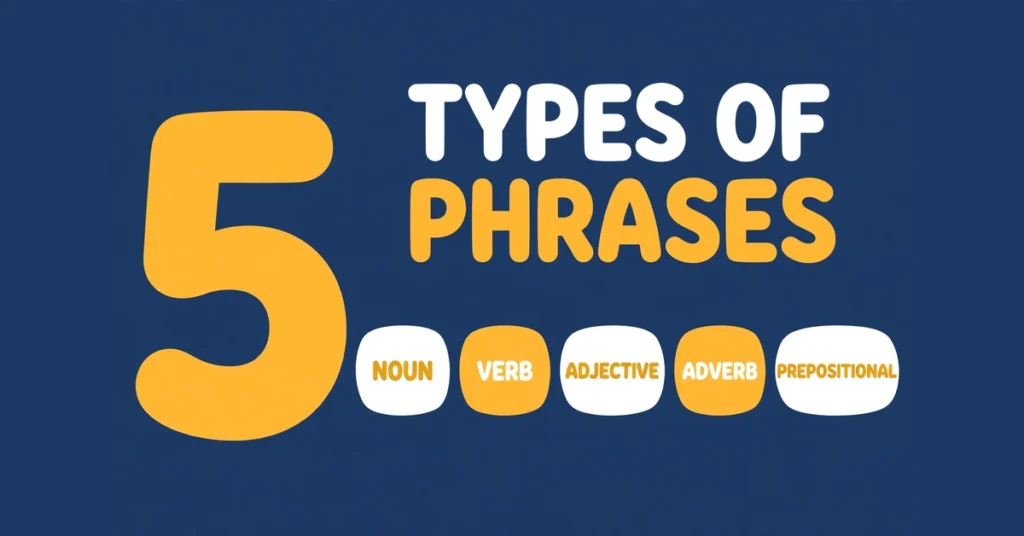
Grade 4 • Types of Phrases • About 20 minutes
You will learn to: name the five core types • sort any phrase by its head word • explain why one phrase can wear two labels
Includes: 5 type cards • an at-a-glance table • 3 sorting rounds • a bonus two-phrase hunt • a full answer key
Curriculum: Anchored in CCSS L.4.1.e (form and use prepositional phrases); supports L.5.3.a (expanding and combining sentences in Grade 5).
Quick answer: The five core types of phrases are noun phrases, verb phrases, adjective phrases, adverb phrases, and prepositional phrases. Each type is named by its head word — the word the whole chunk is built around — and by the job the chunk does as one part of speech.
The Golden Rule: The Head Word Picks the Type
Do not sort a phrase by its first word. Sort it by its head word — the load-bearing word the chunk is built around. The girl with the long braid starts with the, but its head is girl, a noun, so it is a noun phrase. Find the head, and the type names itself.
What Is a Noun? taught you the naming words; Types of Nouns sorted them into families. Phrases work the same way. The post before this one — What Is a Phrase? — taught the two checks that prove a group is a phrase. This post teaches the sorting: they come in different types, and telling them apart is a single skill — find the head word, then ask what job the whole chunk does.
Types of Phrases: The Five You Will Meet First
Built around a noun; does a noun’s jobs.
the little lost puppy
A main verb plus its helpers.
has been sleeping
Describes a noun or pronoun.
full of stars
Tells how, when, where, or why.
with great care
A preposition plus its object.
under the bridge
How Many Types of Phrases Are There?
Ask ten grammar books and you will not get one answer — so here is the honest one. Grammar books do not all list the same types, because some lists stop at the working set and some keep going. School grammar settles on the five above, and those five carry almost every phrase you will meet in elementary writing.
Fuller lists add five more, which you will meet in later grades: participial phrases (sitting by the window), gerund phrases (swimming in cold water, doing a noun’s job), infinitive phrases (to win the race), appositive phrases (my dog, a muddy terrier — a rename tucked beside its noun), and absolute phrases. Learning the core five first is not a shortcut; it is the foundation the other five stand on.
Meet the Five, One by One
1. Noun Phrase — the naming chunk
A noun phrase is built around a noun (its head) and does every job a noun can do: subject, object, or the object after a preposition. The last slice of cake vanished (subject). Ben ate the last slice of cake (object). Everything before the head — the, last — and the describing words after it (of cake) belong to the phrase. Post #18 zooms in on this type alone.
2. Verb Phrase — the action, with its helpers
A verb phrase is a main verb plus any helper verbs in front of it: has been sleeping, will go, is running fast. The helpers stretch the action across time, but remember Post #16’s rule: there is no subject inside the phrase. In Mia has been reading since noon, the phrase is has been reading — Mia stands outside it, doing the job of subject for the whole sentence.
3. Adjective Phrase — the describing chunk
An adjective phrase describes a noun or pronoun, answering which one? or what kind? In The sky, full of stars, looked endless, the chunk full of stars describes sky. A single describing word (starry) is just an adjective; the phrase is the group that does the same job.
4. Adverb Phrase — the how-when-where chunk
An adverb phrase tells how, when, where, or why about a verb, an adjective, or another adverb. He spoke in a whisper (how). We left after dinner (when). The trail led through the woods (where). If the chunk answers one of those questions about the action, it is doing adverb work.
5. Prepositional Phrase — the link chunk
A prepositional phrase is a preposition (in, on, under, between, after…) plus its object — the noun or pronoun the preposition points to — plus any words describing that object: between the two tall fences. This is the type the Grade 4 standard names directly (L.4.1.e: form and use prepositional phrases), and Post #19 is devoted to it.
Every type at a glance:
| Type | Head word | The job it does | Example |
|---|---|---|---|
| Noun phrase | a noun | names a person, place, thing, or idea | the little lost puppy |
| Verb phrase | the main verb | carries the action (with helpers) | has been sleeping |
| Adjective phrase | a describing word at its core | describes a noun or pronoun | full of stars |
| Adverb phrase | a chunk doing adverb work | tells how, when, where, or why | with great care |
| Prepositional phrase | a preposition | links its object to the rest of the sentence | under the bridge |
One Phrase, Two Labels: Shape vs Job
Here is the point that confuses everyone once — and then makes sorting easy forever. Some types are named by their shape, and some by their job. Prepositional is a shape name: any chunk that starts with a preposition and ends with its object wears it. Adjective and adverb are job names: they describe what the chunk does.
So one chunk can honestly wear two labels. In The shop on the corner sells juice, the chunk on the corner is a prepositional phrase by shape doing an adjective job (it tells which shop). In We hid behind the curtain, behind the curtain is the same shape doing an adverb job (it tells where we hid). School grammar files both under “prepositional phrase” — the shape name wins the filing, and the job name explains the work. (The noun-spotter skills from Identifying Nouns help here: the object at the end of a prepositional phrase is always a noun or pronoun.)
Practice Rounds: Sorting Phrases
Three rounds, one per skill. Finish a whole round before peeking at the key.
Round 1 — Name the Type. Name each phrase: noun, verb, adjective, adverb, or prepositional. 1. on the roof 2. the fastest runner in school 3. was carrying the bags 4. very hungry 5. after the storm 6. full of beans 7. in a hurry 8. the boy in the blue shirt
Round 2 — Spot the Head Word. Name the head word of each phrase (for a prepositional phrase, name the object the preposition points to). 1. a basket of fresh eggs 2. is singing loudly 3. in the morning 4. the girl with the braid 5. three tired hikers 6. has been waiting
Round 3 — Two-Label Check. For each bold phrase, give BOTH labels: its shape type and its job. 1. The shop on the corner sells juice. 2. We hid behind the curtain. 3. The cake with the pink icing was gone. 4. They arrived before the bell.
Bonus — Two-Phrase Hunt. This sentence hides four phrases. Find each one and name its type: “The little lost puppy has been sleeping under the porch since noon.”
Answer Key
Check Answers — Full Answer Key (for grown-ups)
Round 1 — Name the Type
1. Prepositional (on + roof). 2. Noun — head word runner. 3. Verb — was carrying: helper + main verb. 4. Adjective — very hungry describes; the chunk does an adjective’s job, grown bigger. 5. Prepositional (after + storm). 6. Adjective — describes (a person full of beans is lively!). 7. Prepositional (in + hurry), doing an adverb job. 8. Noun — head word boy; the words after it describe him.
Round 2 — Spot the Head Word
1. basket (the eggs sit inside its describing words). 2. singing — the main verb; is helps. 3. morning — the object of in. 4. girl. 5. hikers. 6. waiting — the main verb; has been are helpers.
Round 3 — Two-Label Check
1. on the corner — prepositional by shape, adjective by job (which shop?). 2. behind the curtain — prepositional by shape, adverb by job (hid where?). 3. with the pink icing — prepositional by shape, adjective by job (which cake?). 4. before the bell — prepositional by shape, adverb by job (arrived when?).
Bonus — Two-Phrase Hunt
The little lost puppy — noun phrase (the subject). has been sleeping — verb phrase. under the porch — prepositional phrase (adverb job: slept where?). since noon — prepositional phrase (adverb job: slept since when?). One sentence, four phrases, three types — and the noun phrase quietly contains none of the others, because each phrase keeps its own borders.
For Teachers: Running the Practice in Class
Before you start (2 minutes)
- Write the sorting question on the board: Find the head word. What job does the chunk do?
- Model one sort aloud: the girl with the braid → head girl → noun phrase — “not the first word, the head word.”
You need: the rounds above on screen or printed; a pencil per child.
Timing (about 20 minutes): five types 5 • two-label callout 3 • Rounds 1–2 6 • Round 3 + Bonus 4 • check together 2.
Support: give partners the five type cards as a sorting tray; a chunk is not sorted until the pair can say its head word out loud.
Challenge: the Bonus hunt — strong sorters explain why since noon and under the porch share a shape but differ in job.
Quick check: hold up a phrase card; the class labels the phrases they find in their own reading book for one minute and reports the head word for each.
Wrong vs Right: 4 Traps That Catch Phrase Sorters
Trap 1 — Sorting by the first word
❌ Wrong: “The girl with the braid starts with the, so it has no type yet.”
✅ Right: Its head word is girl — a noun phrase. First words are often just helpers (the, a, very); the head word runs the phrase.
Trap 2 — “Exactly five types, forever”
❌ Wrong: “There are only five types of phrases in English.”
✅ Right: Five are the core school types. Fuller lists add participial, gerund, infinitive, appositive, and absolute phrases. Claiming five is the whole universe will be corrected by the very next textbook the student opens.
Trap 3 — Calling every chunk with a verb a verb phrase
❌ Wrong: “Sleeping on the mat, the cat rested” — the chunk has a verb form, so it must be a verb phrase.
✅ Right: A verb phrase is a main verb with its helpers, doing the sentence’s action job (was sleeping). The chunk sleeping on the mat describes the cat — in fuller lists it is a participial phrase; at this level, file it under “describing chunk” and move on.
Trap 4 — One word wearing a phrase’s name
❌ Wrong: “Quickly” is an adverb phrase because it does adverb work.
✅ Right: A single word is never a phrase — a phrase is a group. Very quickly is the adverb phrase; quickly alone is an adverb doing the same job solo.
One-Minute Final Check
Try these without looking back.
1. Name the five core types from memory.
2. Sort it: a jar of pickles — and name its head word.
3. Sort it: will be finished by Friday.
4. Two labels: “The path through the woods was muddy.” Give the shape and the job.
5. True or false: a gerund phrase is one of the five core types.
Check your answers
1. Noun, verb, adjective, adverb, prepositional.
2. Noun phrase — head word jar.
3. Verb phrase — helpers will be + main verb finished.
4. Prepositional by shape, adjective by job (which path?).
5. False — gerund phrases belong to the fuller list, not the core five.
Check Yourself: I Can…
Checked your answers? Tick each box that is true for you:
- ☐ I can name the five types of phrases and give an example of each.
- ☐ I can find the head word before I name a type.
- ☐ I can give a prepositional phrase both labels — its shape and its job.
- ☐ I can say honestly how many types there are — five core types, more in fuller lists.
How did it feel? 😀 I did it! 🙂 Almost — one more try. 🌱 I need more practice.
The trickiest sort I fixed today: ___
Remember: find the head, name the type. Noun, verb, adjective, adverb, prepositional — five core types, each named by the word at its centre and the job the whole chunk does. And when one phrase wears two labels, the shape files it and the job explains it.
Frequently Asked Questions
What are the types of phrases?
The five core types taught at school are noun phrases (the little lost puppy), verb phrases (has been sleeping), adjective phrases (full of stars), adverb phrases (with great care), and prepositional phrases (under the bridge). Fuller grammar lists add participial, gerund, infinitive, appositive, and absolute phrases.
What is a noun phrase?
A noun phrase is a group of words built around a noun that does a noun’s job — subject, object, or object of a preposition. In The sleepy old cat slept, the whole group the sleepy old cat is one noun phrase working as the subject.
What is a prepositional phrase?
A prepositional phrase is a preposition plus its object and any words describing that object: under the bridge, between the two tall fences, after the storm. It is the one phrase type named directly in the Grade 4 Common Core standard (L.4.1.e), because fourth graders must form and use it in their own writing.
Is a verb phrase really a phrase? It has a verb in it.
Yes. Post #16’s rule was never “no verbs” — it was “no subject–verb pair inside the phrase.” A verb phrase holds a main verb and its helpers (has been waiting) but no subject; the subject stands outside the phrase and belongs to the whole sentence.
Can one sentence contain more than one type of phrase?
Easily — most real sentences do. The little lost puppy has been sleeping under the porch since noon holds a noun phrase, a verb phrase, and two prepositional phrases, all in thirteen words. Sorting a sentence means finding each phrase’s borders and naming it on its own.
What is the difference between an adjective phrase and an adverb phrase?
The job. An adjective phrase describes a noun or pronoun (the sky, full of stars). An adverb phrase tells how, when, where, or why about an action or quality (she sang with great care; we left after dinner). Same toolkit, different desk.
What type of phrase is “to win the game”?
An infinitive phrase — one of the fuller-list types, built on to + a verb. In To win the game was her dream it does a noun’s job; in She trained to win the game it tells why. Meeting it now means Grade 6 grammar will feel like a reunion, not a surprise.
Lesson Path: Keep Learning
Step 1 — Learn it: What Is a Phrase? — the two checks every phrase must pass
Step 2 — Sort it: Types of Phrases (you are here)
Step 3 — Zoom in: Noun Phrases — the naming chunk, up close
Step 4 — Practise it: Phrases Worksheet — graded practice with a full answer key
Keep Learning: Your Next Steps
- 🔗 Zoom in first: Noun Phrases — how the naming chunk grows around its head noun.
- 🔗 The Grade 4 star: Prepositional Phrases — the one type the standard names, taught in full.
- 📝 Practise: Phrases Worksheet — printable practice with answers.
- 📗 Types of Nouns: Definition, Examples, and Worksheets for Kids — the hub this post is modelled on: phrases sort the way nouns did.
- 📘 What Is a Noun? — the pillar guide: definition, the three noun tests, 100+ examples.
- 🔎 Identifying Nouns — find the head nouns every noun phrase is built around.

Founder & Editor, Outrenza. Irshad Ullah Asad is a linguist and experienced content writer with an M.Phil in Linguistics. For the past 15 years, he has taught postgraduate classes, helping advanced students master the structure and use of the English language. At Outrenza, he turns that deep expertise into simple, practical grammar lessons — clear explanations, rich examples, and free printable worksheets — so teachers, parents, and students can learn parts of speech and core grammar with confidence. His academic background in linguistics ensures that every lesson on Outrenza is accurate, well-structured, and easy to follow.