
Grade 4 • Pronouns • About 25 minutes
You will learn to: name the 8 kinds of pronouns • sort any pronoun by its job • tell a pointing pronoun from a describing word
Includes: 8 type cards • a pronoun word map • 3 practice rounds • a full answer key
Curriculum: Builds on CCSS L.1.1.d (personal, possessive, and indefinite pronouns); supports L.3.1a and Grade 4 grammar and usage under CCSS L.4.1.
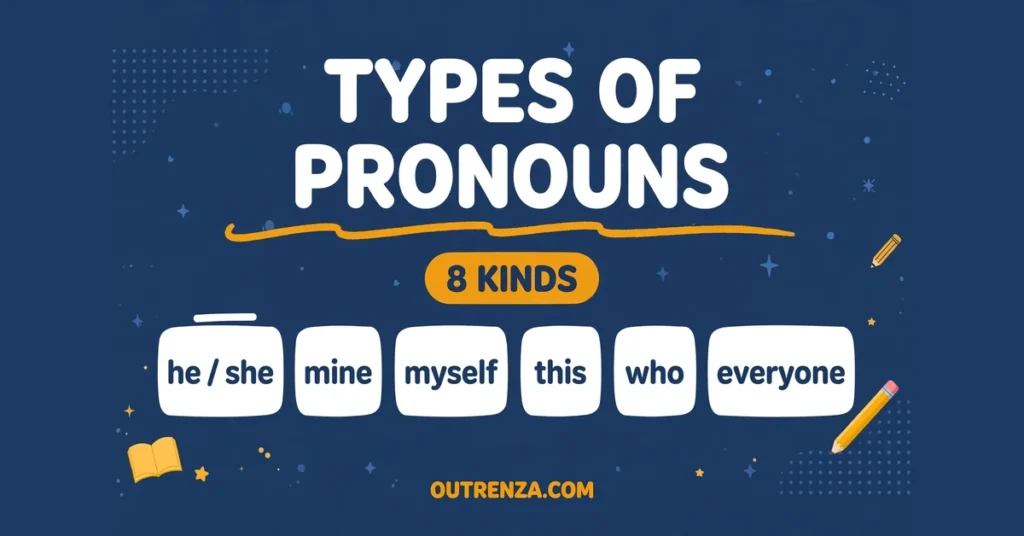
Quick answer: School grammar sorts pronouns into 8 main types of pronouns: personal, possessive, reflexive, demonstrative, interrogative, relative, indefinite, and reciprocal. Every type does a different job — standing for a person, showing an owner, asking a question, or joining two ideas. Learn the job, and the type names itself.
The Job Rule
A pronoun’s kind is its job. Do not ask “what does this word look like?” — ask “what is this word doing?” Is it standing for a person, pointing, asking, or joining? The same word can hold two jobs on two different days: who asks in “Who called?” and joins in “the girl who called.” Job first, label second.
By now you know the stand-ins: small words that take the place of nouns so sentences do not have to repeat names. (Need the naming basics first? What Is a Noun? covers naming words, and the Types of Nouns hub sorts the naming family.) Just like nouns, pronouns come in kinds — and each kind has its own job, its own team of words, and its own traps. This page is your map of the types of pronouns: all 8 kinds, one clear example each, and practice to make the sorting stick.
The 8 Types of Pronouns at a Glance
Stand for people and things.
She gave it to me.
Show an owner, all alone.
The red pen is mine.
Bounce the action back.
He taught himself to swim.
Point at things.
This is my seat.
Ask questions.
Who took my pen?
Join two ideas.
The boy who won smiled.
Name no one in particular.
Someone left a note.
Go two ways at once.
The twins help each other.
Meet the 8 Kinds, One by One
1. Personal Pronouns — The Stand-Ins
The biggest team. Personal pronouns stand for people and things, and they play in two squads: the doers, who start the action — I, you, he, she, it, we, they — and the receivers, who take it — me, you, him, her, it, us, them.
- She baked the pie, and we thanked her for it.
- They beat us by one point.
Watch: you and it play on both squads — the sentence tells you which job they hold.
2. Possessive Pronouns — The Owners That Stand Alone
These show ownership and stand all alone — no noun follows them: mine, yours, his, hers, ours, theirs.
- The blue backpack is mine; the green one is hers.
- That victory was theirs from the first minute.
Watch: their partners — my, your, her, our, their — always stand in front of a noun (my backpack), so many books call them possessive adjectives. The stand-alone owners are the true possessive pronouns, and they never take an apostrophe.
3. Reflexive Pronouns — The Bouncers
They end in -self or -selves and bounce the action back to the doer: myself, yourself, himself, herself, itself, ourselves, yourselves, themselves.
- The cat washed itself in the sun.
- We made the poster ourselves.
Watch: a bouncer needs the doer named first — the cat … itself. Trap 3 below shows what goes wrong without one.
4. Demonstrative Pronouns — The Pointers
They point: this, that, these, those. Near things take this and these; far things take that and those.
- This is my favorite marble.
- Those are not yours.
Watch: when a pointer stands in front of a noun — “this marble” — it is doing a describing job, not a pronoun’s job. Standing alone is the test.
5. Interrogative Pronouns — The Askers
They open questions: who, whom, whose, which, what.
- Who ate the last cookie?
- Which is your umbrella?
Watch: whose asks about owners — “Whose coat is this?” — and it never takes an apostrophe either.
6. Relative Pronouns — The Joiners
They join a describing chunk onto a noun: who, whom, whose, which, that.
- The girl who sits by the window is my cousin.
- The book that won the prize is about oceans.
Watch: joiners look exactly like askers. If the sentence asks, the word is an asker; if it joins, it is a joiner. The job decides.
7. Indefinite Pronouns — The Anybodies
They name no one and nothing in particular: someone, anyone, everyone, no one, something, anything, everything, nothing, many, few, all, some, each, other, another.
- Someone left a wet umbrella by the door.
- Everyone brought something to share.
Watch: many of them sound plural but act singular — “everyone is,” not “everyone are.”
8. Reciprocal Pronouns — The Two-Way Words
Only two: each other and one another. They show an action bouncing between people.
- The two friends waved at each other.
- The players passed the ball to one another.
Watch: two people take each other most often; groups of three or more often take one another — though careful writers use both.
The Whole Family on Four Cards
PERSONAL
I, she, they, me, him, them
OWNERS (STAND-ALONE)
mine, yours, his, hers, ours, theirs
POINTERS & ASKERS
this, that, who, which, what
ANYBODIES & TWO-WAYS
someone, everyone, no one, each other
Keep this map open during the practice rounds. Every bold word below belongs to exactly one card — by job, not by looks.
Practice Rounds: Types of Pronouns in Action
Three rounds: name it, choose it, judge it. Finish each round before peeking at the key.
Round 1 — Name the Type. One bold stand-in hides in each sentence. Name its type. 1. She finished her race first. 2. The blue bike is mine. 3. He taught himself to swim. 4. Those are the winners. 5. Who left the gate open? 6. The girl who sings sits near me. 7. Everyone clapped at the end. 8. The players cheered for each other.
Round 2 — Choose and Sort. Use each word from the bank once. Fill the blank, then name the type. Word bank: she • yours • themselves • these • which • who • everyone • each other. 1. ___ is my best friend. 2. The final choice is ___. 3. They dressed ___ in bright costumes. 4. ___ are my books — the ones right here. 5. ___ is the tallest tower in the city? 6. The singer ___ won the contest thanked the judges. 7. ___ wants a turn on the swing. 8. Good partners listen to ___.
Round 3 — Pronoun or Not a Pronoun? Say “pronoun” or “not a pronoun” for each word. The traps are waiting. 1. himself 2. under 3. quickly 4. someone 5. brave 6. whose 7. pencil 8. they 9. because 10. each other
Answer Key
Check Answers — Full Answer Key (for grown-ups)
Round 1 — Name the Type
1. She — personal. 2. mine — possessive. 3. himself — reflexive. 4. Those — demonstrative. 5. Who — interrogative (it asks). 6. who — relative (it joins). 7. Everyone — indefinite. 8. each other — reciprocal.
Round 2 — Choose and Sort
1. She — personal. 2. yours — possessive. 3. themselves — reflexive. 4. These — demonstrative. 5. Which — interrogative. 6. who — relative. 7. Everyone — indefinite. 8. each other — reciprocal.
Round 3 — Pronoun or Not a Pronoun?
1. himself — pronoun (reflexive). 2. under — not (a position word). 3. quickly — not (it describes an action). 4. someone — pronoun (indefinite). 5. brave — not (a describing word). 6. whose — pronoun (an asker about owners). 7. pencil — not (a noun). 8. they — pronoun (personal). 9. because — not (it joins parts of a sentence; it stands for nothing). 10. each other — pronoun (reciprocal).
Key note: Rounds 1 and 2 both hide the same trick — sentences 5 and 6 hold the same word, who, doing two different jobs. The job names the type, every time.
For Teachers: Running the Practice in Class
Before you start (3 minutes)
- Write the Job Rule on the board: job first, label second.
- Sort one word together both ways: who in a question, then who as a joiner.
You need: the 8-card grid and the four word cards visible; a pencil per child.
Timing (about 25 minutes): map + grid 5 • kinds tour 8 • rounds 8 • check together 4.
Support: let students keep the grid open during the rounds; sort in pairs and say the job out loud before the label.
Challenge: Round 1, sentences 5 and 6 — same word, two jobs. Ask: “What changed — the word, or the work it does?”
Quick check: read a sentence with one bold word — students hold up fingers 1–8 for its number on the grid.
Wrong vs Right: 4 Traps That Catch Pronoun Sorters
Trap 1 — Pointer or describer?
❌ Wrong: Calling this a pronoun in “This cake is tasty.”
✅ Right: In “This cake…,” this stands in front of a noun and describes it — a describing job. In “This is tasty,” it stands alone — that is the pronoun job. Alone = pronoun; in front = describer.
Trap 2 — Its or it’s?
❌ Wrong: “The cat licked it’s paws.”
✅ Right: “The cat licked its paws.” Its is the owner word and never wears an apostrophe; it’s always means it is. (Owner nouns do the opposite — they take one: Possessive Nouns.)
Trap 3 — A bouncer with nobody to bounce from
❌ Wrong: “Give the form to myself.”
✅ Right: “Give the form to me.” Reflexive words need the doer in the sentence first — “I did it myself.” No I, no myself.
Trap 4 — The starter swap
❌ Wrong: “Me and she are partners.”
✅ Right: “She and I are partners.” Drop the partner and listen: “Me am partners” fails; “I am” works. Starters are she and I; receivers are her and me.
One-Minute Final Check
Try these without looking back.
1. What type is themselves in “They dressed themselves”?
2. What type is whose in “Whose pen is this?”?
3. True or false: in “This cake is tasty,” this is doing a pronoun’s job.
4. Name the joiner: “The team that practices wins.”
5. Which word is an indefinite pronoun: someone, quickly, under?
Check your answers
1. reflexive.
2. interrogative — it asks about an owner.
3. False — this describes the cake; standing alone (“This is tasty”) it would be a pronoun.
4. that — a relative pronoun.
5. someone.
Check Yourself: I Can…
Checked your answers? Tick each box that is true for you:
- ☐ I can name all 8 types without looking.
- ☐ I can sort a bold pronoun by asking what job it does.
- ☐ I can tell a pointer pronoun from a describing this.
- ☐ I can choose between each other and themselves.
How did it feel? 😀 I did it! 🙂 Almost — one more try. 🌱 I need more practice.
The type I mix up most: ___
Remember: the job names the type. Do not sort by how a word looks — sort by what it does. Stands for a person? Personal. Owns, all alone? Possessive. Bounces back? Reflexive. Points? Demonstrative. Asks? Interrogative. Joins? Relative. Names nobody in particular? Indefinite. Goes two ways? Reciprocal.
Frequently Asked Questions
How many kinds of pronouns are there?
Most school grammars name 8 types of pronouns: personal, possessive, reflexive, demonstrative, interrogative, relative, indefinite, and reciprocal. Some books split the personal words into two lists — the doers and the receivers — or count partner words like my as a type of their own, so totals can differ from book to book. The jobs stay the same in every book.
What are the types of pronouns?
Here is the whole family in one breath: personal (she, them), possessive (mine, theirs), reflexive (himself, ourselves), demonstrative (this, those), interrogative (who, which), relative (who, that), indefinite (someone, everyone), and reciprocal (each other, one another). Each one stands in for a noun in its own way.
Is “that” a pronoun?
It can be — that holds three jobs. Standing alone, it points: “That is mine” (demonstrative). After a noun, it joins: “the book that won” (relative). In front of a noun, it describes: “that book” — a describing job, not a pronoun’s job. The sentence decides.
Is “my” a pronoun?
Nearly. My belongs to the owner family, but it always stands in front of a noun — my book — so many books call it a possessive adjective. The possessive pronoun is its stand-alone partner: mine — “The book is mine.” A post later in this series puts my and mine side by side.
What is the difference between interrogative and relative pronouns?
They share words — who, whom, whose, which — but not jobs. An interrogative word asks: “Who called?” A relative word joins a describing chunk to a noun: “the girl who called.” Question mark at the end? It asked. No question? It joined.
Can one word belong to two types?
Yes — the word stays the same, the job changes. Who asks in one sentence and joins in another; that points, joins, and describes. That is why this page sorts by job, never by spelling. When you are stuck, ask what the word is doing, and the type will follow.
Lesson Path: Keep Learning
Step 1 — Nouns first: What Is a Noun? — the pillar guide to naming words
Step 2 — Meet the stand-ins: What Is a Pronoun? — the Stand-In Rule and the great swap
Step 3 — Sort them: Types of Pronouns (you are here)
Step 4 — Go deeper: Personal Pronouns: Subject and Object — the doers and the receivers, settled
Keep Learning: Your Next Steps
- 📗 Types of Nouns: Definition, Examples, and Worksheets for Kids — the hub this page mirrors: all 10 noun types, with a printable chart.
- 🔍 Identifying Nouns: How to Find Every Noun in a Sentence — find the names first; then their stand-ins make sense.
- 📘 Possessive Nouns: Rules, Examples, and Practice for Grade 3 — owner nouns with apostrophes, the mirror image of the owner pronouns.
- 📝 Nouns Worksheet for Grade 4 — Free Printable with Answers — a mixed noun review at this grade level.
- 🔗 Coming next: Personal Pronouns: Subject and Object — I vs. me, he vs. him, settled for good.
- 🔗 Also in this series: Possessive Pronouns vs Possessive Adjectives — mine vs. my, side by side.
- 🔗 Practice ahead: Pronouns Worksheet for Grade 4 — the whole pronoun family in one printable review.

Founder & Editor, Outrenza. Irshad Ullah Asad is a linguist and experienced content writer with an M.Phil in Linguistics. For the past 15 years, he has taught postgraduate classes, helping advanced students master the structure and use of the English language. At Outrenza, he turns that deep expertise into simple, practical grammar lessons — clear explanations, rich examples, and free printable worksheets — so teachers, parents, and students can learn parts of speech and core grammar with confidence. His academic background in linguistics ensures that every lesson on Outrenza is accurate, well-structured, and easy to follow.